慢性蕁麻疹施打喜瑞樂 6 年後,仍有一半的人停藥就復發 - 以色列研究
慢性蕁麻疹吃抗組織胺控制不好時,常會改打生物製劑喜瑞樂(Xolair)。
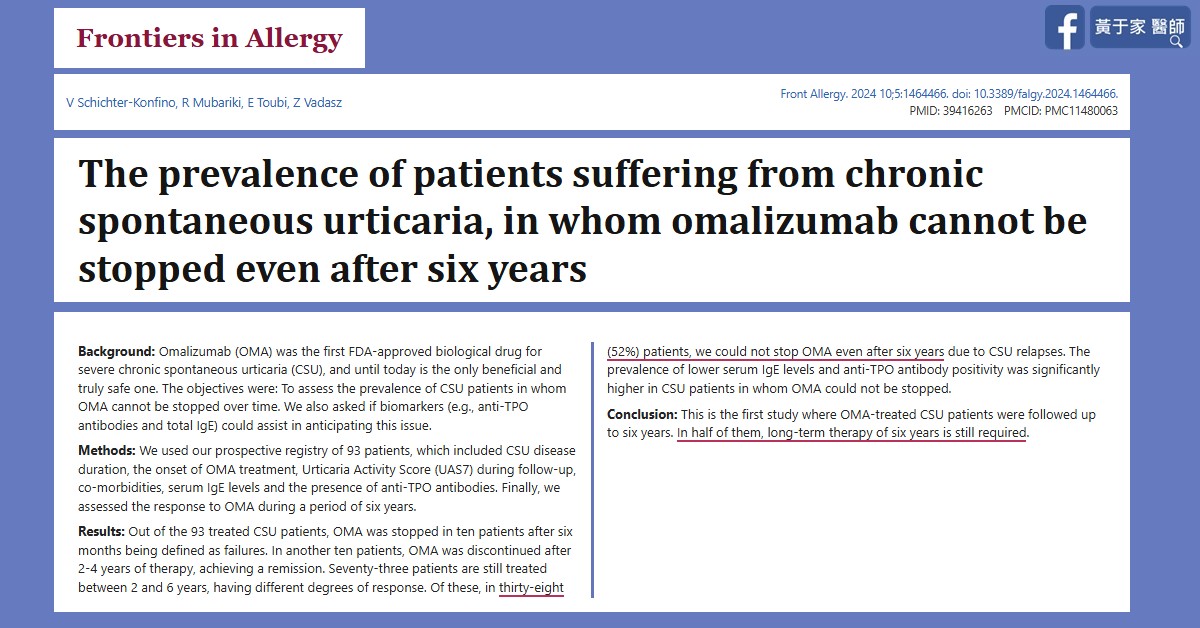
這篇以色列研究追蹤 93 位患者長達 6 年:10 人治療 6 個月無效而停藥,10 人在治療 2 到 4 年後緩解停藥。
仍在治療的 73 人中,有 38 人(52%)一停就復發,用了 6 年還是停不了。
作者的結論是:一半的患者,6 年後仍需要長期治療。
我的門診也有喜瑞樂施打六年後失效,以及自費注射喜瑞樂僅短效,反覆施打了四年才來求診的慢性蕁麻疹患者。
後面這位患者停中藥半年後來信告訴我:這半年多來,慢性蕁麻疹全無發作紀錄。
對照先前整理的楊賢鴻教授慢性蕁麻疹研究,先前有吃中藥一個月的患者,在停服中藥後,搔癢程度還持續減輕。
慢性蕁麻疹需要的,不只是壓住症狀,而是讓體質穩定下來,停藥之後也能過得安穩。
本篇研究,“The prevalence of patients suffering from chronic spontaneous urticaria, in whom omalizumab cannot be stopped even after six years”,期刊摘要如下:
Background:
Omalizumab (OMA) was the first FDA-approved biological drug for severe chronic spontaneous urticaria (CSU), and until today is the only beneficial and truly safe one. The objectives were: To assess the prevalence of CSU patients in whom OMA cannot be stopped over time. We also asked if biomarkers (e.g., anti-TPO antibodies and total IgE) could assist in anticipating this issue.
Methods:
We used our prospective registry of 93 patients, which included CSU disease duration, the onset of OMA treatment, Urticaria Activity Score (UAS7) during follow-up, co-morbidities, serum IgE levels and the presence of anti-TPO antibodies. Finally, we assessed the response to OMA during a period of six years.
Results:
Out of the 93 treated CSU patients, OMA was stopped in ten patients after six months being defined as failures. In another ten patients, OMA was discontinued after 2-4 years of therapy, achieving a remission. Seventy-three patients are still treated between 2 and 6 years, having different degrees of response. Of these, in thirty-eight (52%) patients, we could not stop OMA even after six years due to CSU relapses. The prevalence of lower serum IgE levels and anti-TPO antibody positivity was significantly higher in CSU patients in whom OMA could not be stopped.
Conclusion:
This is the first study where OMA-treated CSU patients were followed up to six years. In half of them, long-term therapy of six years is still required.
原始論文
Schichter-Konfino V, Mubariki R, Toubi E, Vadasz Z. Frontiers in Allergy. 2024;5:1464466. doi:10.3389/falgy.2024.1464466
本文摘要依 CC BY 4.0 授權轉載,著作權屬原作者。
論文摘要(中文翻譯)
以下為中文翻譯,僅供參考,內容以英文原文為準。
慢性自發性蕁麻疹患者中,omalizumab 即使用了 6 年仍無法停藥的比例
背景:Omalizumab 是美國食品藥物管理局(FDA)第一個核准用於嚴重慢性自發性蕁麻疹的生物製劑,至今仍是唯一有效且真正安全的一種。本研究目的是評估隨著時間過去,無法停用 omalizumab 的慢性自發性蕁麻疹患者比例;同時探討生物標記(例如抗甲狀腺過氧化酶抗體與總 IgE)能否幫助預測這個情形。
方法:我們使用自己的前瞻性登錄資料,共 93 位患者,內容包括慢性自發性蕁麻疹病程、開始 omalizumab 治療的時間、追蹤期間的蕁麻疹活性分數(UAS7)、共病、血清 IgE 濃度,以及是否有抗甲狀腺過氧化酶抗體。最後評估 6 年期間對 omalizumab 的反應。
結果:93 位接受治療的患者中,10 位在 6 個月後停藥,判定為治療失敗;另有 10 位在治療 2 到 4 年後達到緩解而停藥。73 位患者仍在治療中,已用藥 2 到 6 年,反應程度不一;其中 38 位(52%)因蕁麻疹復發,即使用了 6 年仍無法停藥。無法停藥的患者,血清 IgE 較低與抗甲狀腺過氧化酶抗體陽性的比例明顯較高。
結論:這是第一個追蹤 omalizumab 治療慢性自發性蕁麻疹患者長達 6 年的研究。其中一半的患者,用藥 6 年後仍需要繼續長期治療。
相關治療紀錄
- 慢性蕁麻疹,喜瑞樂 Xolair 施打六年後失效
- 慢性蕁麻疹,十年,自費注射喜瑞樂僅短效
- 十年的蕁麻疹,停藥半年之後呢?
- 慢性蕁麻疹,三年,自費注射喜瑞樂九個月僅能短效
- 慢性蕁麻疹,中醫經方的治療實例
- 諸多患者停服中藥後的實況追蹤