普查近一萬名慢性蕁麻疹患者:慢性蕁麻疹與異位性皮膚炎密切相關 - 台灣健保資料庫研究
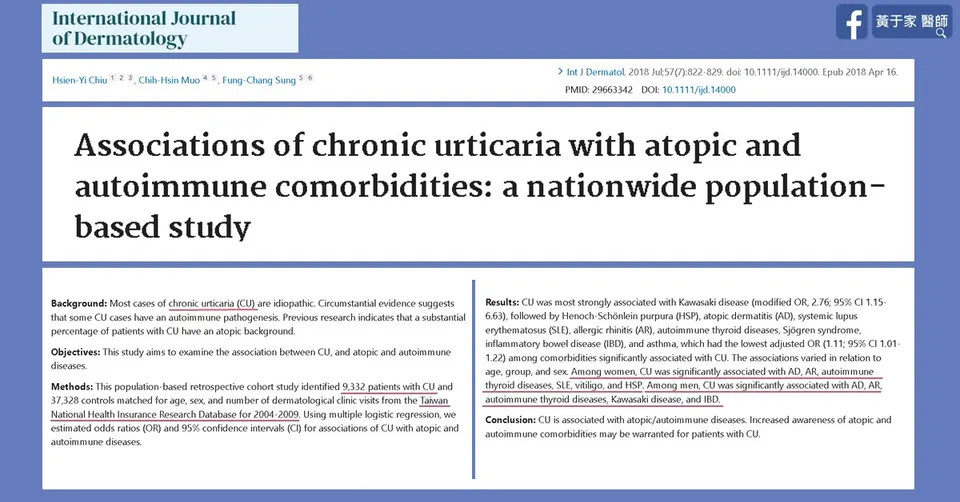
本篇研究,“Associations of chronic urticaria with atopic and autoimmune comorbidities:a nationwide population-based study”,請見這裡(外部網站),期刊摘要如下:
Background:
Most cases of chronic urticaria (CU) are idiopathic. Circumstantial evidence suggests that some CU cases have an autoimmune pathogenesis. Previous research indicates that a substantial percentage of patients with CU have an atopic background.
Objectives:
This study aims to examine the association between CU, and atopic and autoimmune diseases.
Methods:
This population-based retrospective cohort study identified 9,332 patients with CU and 37,328 controls matched for age, sex, and number of dermatological clinic visits from the Taiwan National Health Insurance Research Database for 2004-2009.
Using multiple logistic regression, we estimated odds ratios (OR) and 95% confidence intervals (CI) for associations of CU with atopic and autoimmune diseases.
Results:
CU was most strongly associated with Kawasaki disease (modified OR, 2.76; 95% CI 1.15-6.63), followed by Henoch-Schönlein purpura (HSP), atopic dermatitis (AD), systemic lupus erythematosus (SLE), allergic rhinitis (AR), autoimmune thyroid diseases, Sjögren syndrome, inflammatory bowel disease (IBD), and asthma, which had the lowest adjusted OR (1.11; 95% CI 1.01-1.22) among comorbidities significantly associated with CU.
The associations varied in relation to age, group, and sex.
Among women, CU was significantly associated with AD, AR, autoimmune thyroid diseases, SLE, vitiligo, and HSP.
Among men, CU was significantly associated with AD, AR, autoimmune thyroid diseases, Kawasaki disease, and IBD.
Conclusion:
CU is associated with atopic/autoimmune diseases. Increased awareness of atopic and autoimmune comorbidities may be warranted for patients with CU.
原始論文
Chiu HY, Muo CH, Sung FC. International Journal of Dermatology. 2018;57(7):822-829. doi:10.1111/ijd.14000
論文摘要(Google 翻譯)
以下為 Google 翻譯,並校正明顯錯誤,僅供參考,內容以英文原文為準。
慢性蕁麻疹與異位性及自體免疫共病的關聯:一項全國性族群研究
背景:大多數慢性蕁麻疹(CU)病例為特發性(原因不明)。間接證據顯示部分 CU 病例具有自體免疫的致病機轉。先前研究指出,相當比例的 CU 患者具有異位性體質背景。
目的:本研究旨在探討 CU 與異位性疾病及自體免疫疾病之間的關聯。
方法:這項以族群為基礎的回溯性世代研究,從 2004–2009 年台灣全民健康保險研究資料庫中,找出 9,332 名 CU 患者,以及年齡、性別與皮膚科就診次數相配對的 37,328 名對照者。
以多變項邏輯斯迴歸估計 CU 與異位性及自體免疫疾病關聯的勝算比(OR)及 95% 信賴區間(CI)。
結果:CU 與川崎病的關聯最強(修正後 OR 2.76;95% CI 1.15–6.63),其次為亨諾-許蘭氏紫斑症(HSP)、異位性皮膚炎(AD)、全身性紅斑性狼瘡(SLE)、過敏性鼻炎(AR)、自體免疫甲狀腺疾病、修格蘭氏症候群、發炎性腸道疾病(IBD),以及氣喘;在與 CU 顯著相關的共病中,氣喘的校正後 OR 最低(1.11;95% CI 1.01–1.22)。
這些關聯依年齡、組別與性別而有所不同。
在女性中,CU 與 AD、AR、自體免疫甲狀腺疾病、SLE、白斑症及 HSP 顯著相關。
在男性中,CU 與 AD、AR、自體免疫甲狀腺疾病、川崎病及 IBD 顯著相關。
結論:CU 與異位性/自體免疫疾病相關。對 CU 患者,可能需要提高對異位性與自體免疫共病的警覺。
慢性蕁麻疹,中醫經方的治療實例,請見這裡。
異位性皮膚炎,中醫經方的治療實例,請見這裡。
慢性蕁麻疹,期刊研究,請看這裡。
異位性皮膚炎,期刊研究,請看這裡。
期刊研究整理,請見這裡。
接下來讀這幾篇


原文發表於 作者部落格(舊部落格)。