跳下去是不是就可以不再癢了?研究結果:慢性蕁麻疹常合併心理疾病,不能只處理皮膚,需整合治療
慢性蕁麻疹,中醫經方的治療實例,請見這裡。
慢性蕁麻疹,期刊研究,請看這裡。
期刊研究整理,請見這裡。
本篇研究,請見這裡(外部網站)。
原始論文
Psychiatric comorbidity in chronic urticaria patients: a systematic review and meta-analysis(外部網站)
Konstantinou GN, Konstantinou GN. Clinical and Translational Allergy. 2019;9:42. doi:10.1186/s13601-019-0278-3
論文摘要(英文原文)
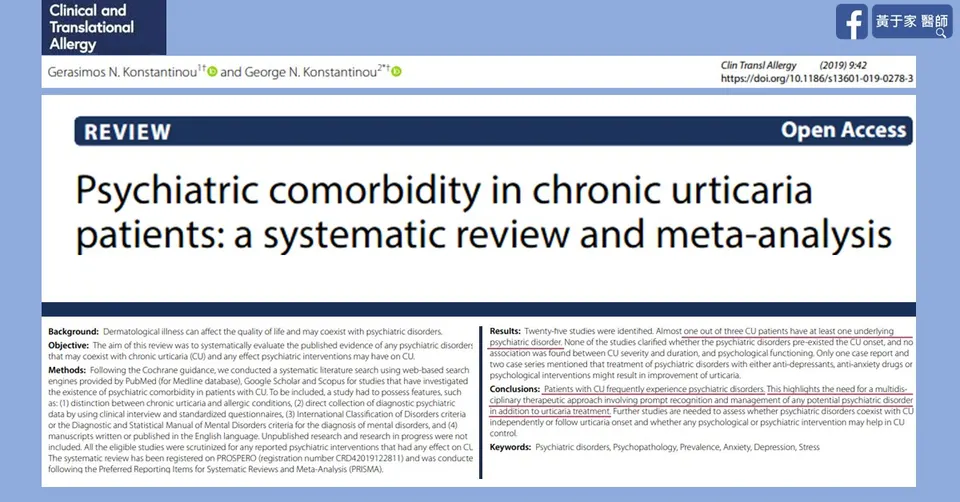
Psychiatric comorbidity in chronic urticaria patients: a systematic review and meta-analysis
Background: Dermatological illness can affect the quality of life and may coexist with psychiatric disorders.
Objective: The aim of this review was to systematically evaluate the published evidence of any psychiatric disorders that may coexist with chronic urticaria (CU) and any effect psychiatric interventions may have on CU.
Methods: Following the Cochrane guidance, we conducted a systematic literature search using web-based search engines provided by PubMed (for Medline database), Google Scholar and Scopus for studies that have investigated the existence of psychiatric comorbidity in patients with CU. To be included, a study had to possess features, such as: (1) distinction between chronic urticaria and allergic conditions, (2) direct collection of diagnostic psychiatric data by using clinical interview and standardized questionnaires, (3) International Classification of Disorders criteria or the Diagnostic and Statistical Manual of Mental Disorders criteria for the diagnosis of mental disorders, and (4) manuscripts written or published in the English language. Unpublished research and research in progress were not included. All the eligible studies were scrutinized for any reported psychiatric interventions that had any effect on CU. The systematic review has been registered on PROSPERO (registration number CRD42019122811) and was conducted following the Preferred Reporting Items for Systematic Reviews and Meta-Analysis (PRISMA).
Results: Twenty-five studies were identified. Almost one out of three CU patients have at least one underlying psychiatric disorder. None of the studies clarified whether the psychiatric disorders pre-existed the CU onset, and no association was found between CU severity and duration, and psychological functioning. Only one case report and two case series mentioned that treatment of psychiatric disorders with either anti-depressants, anti-anxiety drugs or psychological interventions might result in improvement of urticaria.
Conclusions: Patients with CU frequently experience psychiatric disorders. This highlights the need for a multidisciplinary therapeutic approach involving prompt recognition and management of any potential psychiatric disorder in addition to urticaria treatment. Further studies are needed to assess whether psychiatric disorders coexist with CU independently or follow urticaria onset and whether any psychological or psychiatric intervention may help in CU control.
摘要引自原始論文,依 CC BY 4.0(外部網站) 授權轉載。
論文摘要(Google 翻譯)
以下為 Google 翻譯,並校正明顯錯誤,僅供參考,內容以英文原文為準。
慢性蕁麻疹患者的精神合併症:系統性回顧與統合分析
背景:皮膚病會影響生活品質,並可能與精神疾病共存。
目的:本綜述的目的是系統性評估已發表的可能與慢性蕁麻疹 (CU) 共存的任何精神疾病的證據,以及精神干預措施可能對 CU 產生的任何影響。
方法:按照 Cochrane 指導,我們使用 PubMed(Medline 資料庫)、Google Scholar 和 Scopus 提供的網路搜尋引擎進行了系統性的文獻檢索,以調查 CU 患者是否有精神共病。納入的研究須具備以下條件:(1)區分慢性蕁麻疹與過敏性疾病,(2)透過臨床訪談和標準化問卷直接收集診斷精神數據,(3)國際疾病分類標準或《精神疾病診斷和統計手冊》精神疾病診斷標準,以及(4)以英語撰寫或發表的手稿。未發表的研究和正在進行的研究不包括在內。所有符合條件的研究均經過仔細審查,以了解任何報告的對 CU 有影響的精神干預措施。系統性回顧已在 PROSPERO 上註冊(註冊號 CRD42019122811),並依照系統性回顧和統合分析的首選報告項目(PRISMA)進行。
結果:確定了 25 項研究。幾乎三分之一的 CU 患者至少患有一種潛在的精神疾病。所有研究均未澄清 CU 發病前是否有精神疾病,也未發現 CU 嚴重程度、持續時間與心理功能之間有關聯。只有一份病例報告和兩個病例系列提到,用抗憂鬱藥物、抗焦慮藥物或心理干預治療精神疾病可能會改善蕁麻疹。
結論:CU 患者經常出現精神疾病。這突顯出需要採取多學科治療方法,除了蕁麻疹治療之外,還需要及時識別和管理任何潛在的精神疾病。需要進一步的研究來評估精神疾病是否與 CU 獨立共存或跟隨蕁麻疹發作,以及是否任何心理或精神干預可能有助於 CU 控制。
接下來讀這幾篇
原文發表於 作者部落格(舊部落格)。