中藥不只是「有吃有效、沒吃沒效」之實證:摘自楊賢鴻教授之慢性蕁麻疹研究
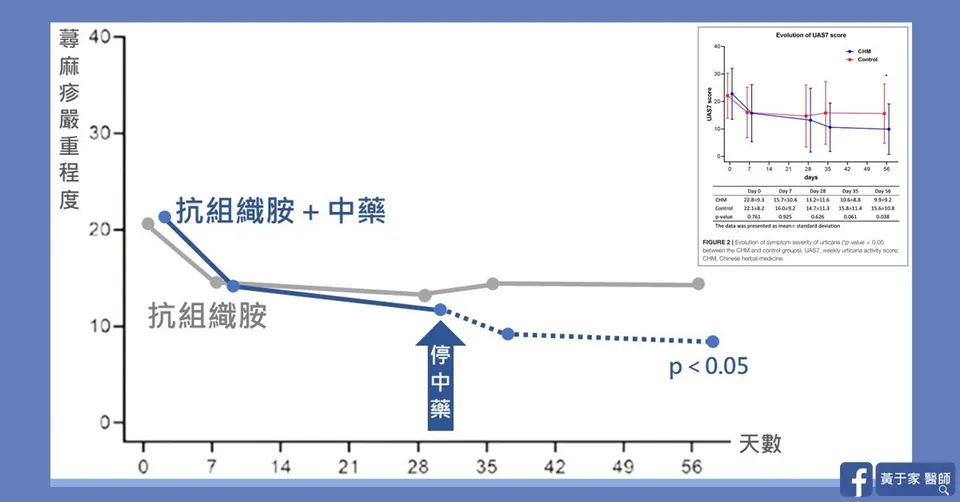
依據長庚大學中醫學系楊賢鴻教授(外部網站)之慢性蕁麻疹研究,請見全文連結(外部網站)。
“The Efficacy and Safety of a Fixed Combination of Chinese Herbal Medicine in Chronic Urticaria:
A Randomized, Double-Blind, Placebo-Controlled Pilot Study”
實驗分成兩組,一組吃抗組織胺和安慰劑,另一組吃抗組織胺和中藥,持續一個月。
然後中藥暫停,兩組改成都只吃抗組織胺,再一個月。
結果發現,先前有吃中藥一個月的,在停服中藥後,慢性蕁麻疹搔癢程度還會持續減輕,甚至在第八周時,與從沒吃中藥的組別相較,搔癢程度在統計上具顯著差異(p value<0.05)。
感謝楊教授的研究,驗證了中藥不是有吃有效、沒吃就沒效。
此研究結果也與楊賢鴻教授之訪談(外部網站)內容相呼應:
「西藥有抗組織胺、類固醇這些藥物,但病人的困擾是一停西藥後病情很快會再度發生。
西藥偏向在『下游』做阻斷,雖然見效,但停藥後上游的過敏訊號仍會不斷往下傳,導致一停抗組織胺、類固醇症狀就會迅速回復。
中藥處理免疫問題,是從『上游』處理,病人停藥後,體質仍會處於相對穩定的狀態,因此不易反覆過敏。
這就是中藥和西藥治療過敏性疾病的最大差別。」
原始論文
Yang SH, Lin YH, Lin JR, Chen HY, et al. Frontiers in Pharmacology. 2018;9:1474. doi:10.3389/fphar.2018.01474
論文摘要(英文原文)
The Efficacy and Safety of a Fixed Combination of Chinese Herbal Medicine in Chronic Urticaria: A Randomized, Double-Blind, Placebo-Controlled Pilot Study
Background: Chronic urticaria is a bothersome skin disease, and Chinese herbal medicine (CHM) is commonly used as adjuvant therapy. This study aimed to evaluate the effectiveness and safety of the mixture of two CHM formula, Xiao-Feng-San (XFS) and Qing-Shang-Fang-Feng-Tang (QSFFT), in treating urticaria through a randomized, double-blind, placebo-controlled clinical trial.
Methods: 78 participants entered the screening phase between November 2012 and August 2015. Participants were randomly and equally allocated in either CHM group (2 gm XFS and 2 gm QSFFT four times a day and 5 mg levocetirizine once daily for 28 days followed by 5 mg levocetirizine once daily alone for 28 days) or control group (placebo and 5 mg levocetirizine daily followed by 5 mg levocetirizine once daily for 28 days alone). Symptom improvement was set as the primary outcome, and the influence on sleep quality and changes in serum markers were used as secondary outcomes. Per protocol design was applied to the final analysis.
Results: A total of 56 participants entered the final analysis stage. Participants in the CHM group had more prominent symptom relief on day 56 (the weekly urticaria activity score, UAS7, as 9.9 ± 9.2 vs. 15.6 ± 10.8, p = 0.038). In the CHM group, participants’ symptom severity reduced progressively (trend analysis, p < 0.001) while the decreasing trend was less favored in the control group (trend analysis, p = 0.056). The life quality improved gradually in both groups, while the differences between CHM and control groups were statistically insignificant. For urticaria-related cytokines, interferon-γ seemed to decrease positively in the CHM group (about 30.8% reduction from baseline, trend analysis p = 0.013). For safety issue, the CHM prescription was well-tolerated with no noticeable long-term side effects when compared to the control group. At 6-month follow-up of symptom changes after the end of the trial, the CHM group participants reported positive results in no recurrence or ≥50% improvement (36.3% in CHM group vs. 20% in Control group, p = 0.103).
Conclusions: The combination of XFS and QSFFT tended to be feasible and tolerable adjuvant therapy for urticaria in addition to standard therapy. However, larger study population with longer follow-up duration may be still needed.
Trial registration: NCT01715740 (ClinicalTrials.gov).
摘要引自原始論文,依 CC BY 4.0(外部網站) 授權轉載。
論文摘要(Google 翻譯)
以下為 Google 翻譯,並校正明顯錯誤,僅供參考,內容以英文原文為準。
中草藥固定組合治療慢性蕁麻疹的療效和安全性:隨機、雙盲、安慰劑對照初步研究
背景:慢性蕁麻疹是一種令人困擾的皮膚病,常用中草藥(CHM)作為輔助治療。本研究旨在透過隨機、雙盲、安慰劑對照臨床試驗,評估兩種中藥方劑消風散(XFS)和清上防風湯(QSFFT)的混合物治療蕁麻疹的有效性和安全性。
方法:2012 年 11 月至 2015 年 8 月期間,共 78 位參與者進入篩選階段。參與者被隨機平均分配到中藥組(消風散 2 公克及清上防風湯 2 公克,每天四次,並服用左西替利嗪 5 mg 每天一次,持續 28 天;之後單獨服用左西替利嗪 5 mg 每天一次,持續 28 天)或對照組(安慰劑及左西替利嗪 5 mg 每天一次;之後單獨服用左西替利嗪 5 mg 每天一次,持續 28 天)。以症狀改善為主要結果,對睡眠品質的影響及血清標記的變化為次要結果。最終分析採用符合計畫書(per protocol)分析。
結果:共有 56 名參與者進入最終分析階段。 CHM 組的參與者在第 56 天有更顯著的症狀緩解(每週蕁麻疹活動評分,UAS7,分別為 9.9 ± 9.2 與 15.6 ± 10.8,p = 0.038)。在中藥組中,參與者的症狀嚴重程度逐漸減輕(趨勢分析,p < 0.001),而對照組的症狀嚴重程度則較不明顯(趨勢分析,p = 0.056)。兩組生活品質均逐漸改善,而中藥組與對照組差異無統計學意義。對於蕁麻疹相關細胞因子,CHM 組中干擾素-γ 似乎呈現正向下降(較基線下降約 30.8%,趨勢分析 p = 0.013)。就安全性而言,與對照組相比,中藥處方具有良好的耐受性,沒有明顯的長期副作用。在試驗結束後 6 個月的症狀變化追蹤中,CHM 組參與者報告了無復發或改善≥50% 的正面結果(CHM 組為 36.3%,對照組為 20%,p = 0.103)。
結論:XFS 和 QSFFT 合併治療蕁麻疹是除標準治療外可行且可耐受的輔助治療。然而,可能仍需要更大的研究族群和更長的追蹤時間。
試驗註冊:NCT01715740 (ClinicalTrials.gov)。
慢性蕁麻疹,中醫經方的治療實例,請見這裡。
停中藥後的患者現況追蹤,請見這裡。
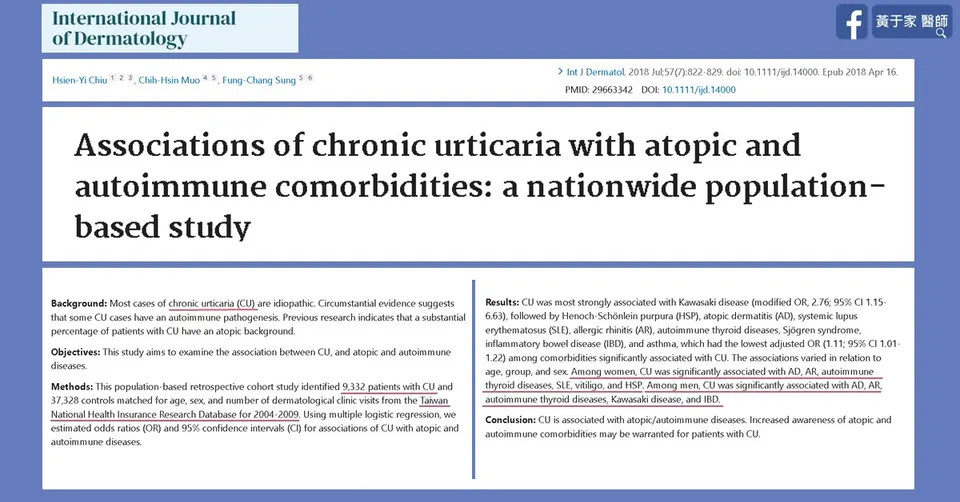
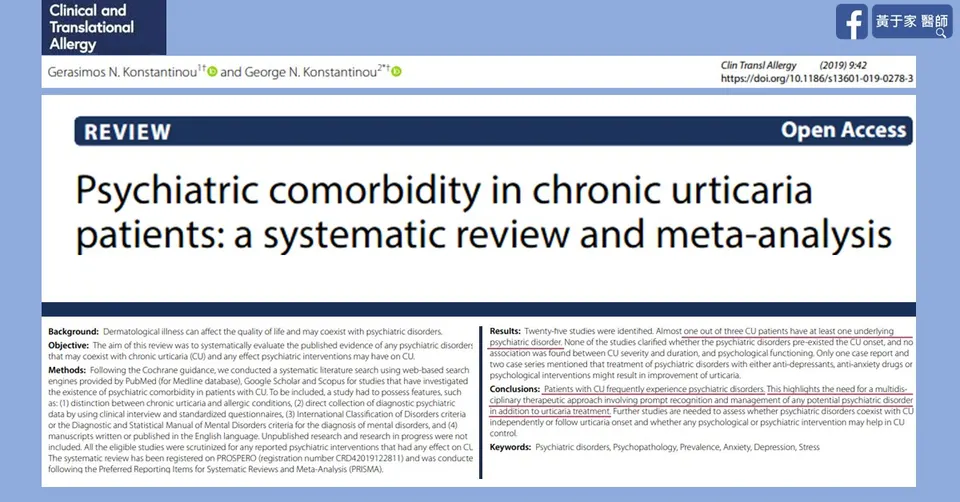
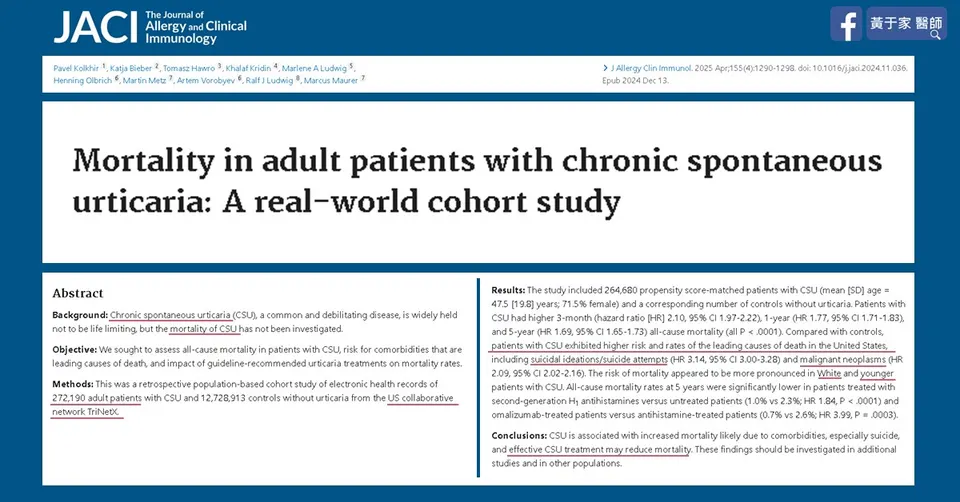
慢性蕁麻疹,期刊研究,請看這裡。
期刊研究整理,請見這裡。
接下來讀這幾篇
原文發表於 作者部落格(舊部落格)。