異位性皮膚炎患者較容易得帶狀疱疹,病情越重、使用類固醇或小分子藥物,風險更高 - 整理四篇研究
帶狀疱疹是小時候得過的水痘病毒,躲在神經裡,等身體抵抗力變差時再發作。
一般認為帶狀疱疹是年紀大的人才會得的病,但這幾年陸續有研究發現,異位性皮膚炎患者也要多留意。
這篇把四篇研究整理在一起,說明研究看到了什麼,以及治療時可以怎麼做。
研究看到了什麼
台灣,28,677 位異位性皮膚炎患者(2023)
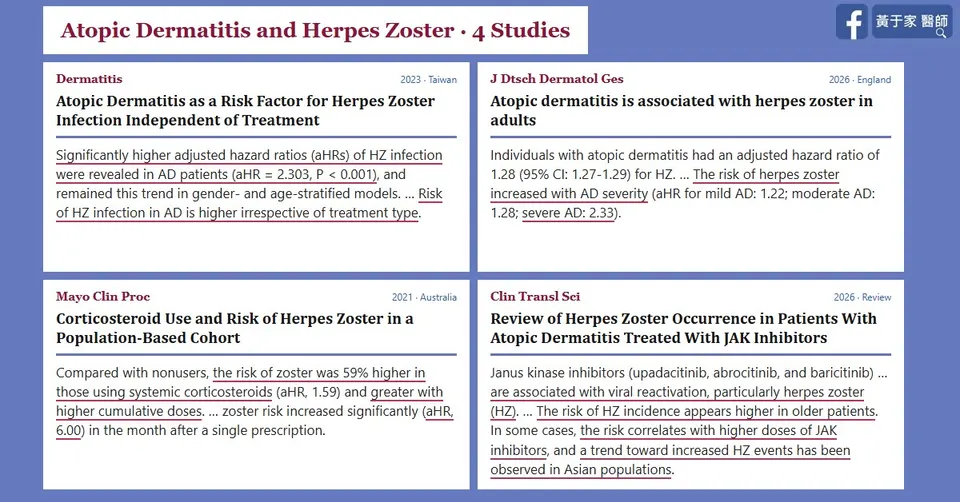
三軍總醫院團隊用台灣健保資料庫發現,異位性皮膚炎患者得帶狀疱疹的風險,是一般人的 2.3 倍。
不論男女、不論年齡層,都是同樣的趨勢;就算沒有用口服或注射的藥,風險也一樣比較高。
英國,約 1,300 萬位成人(2026)
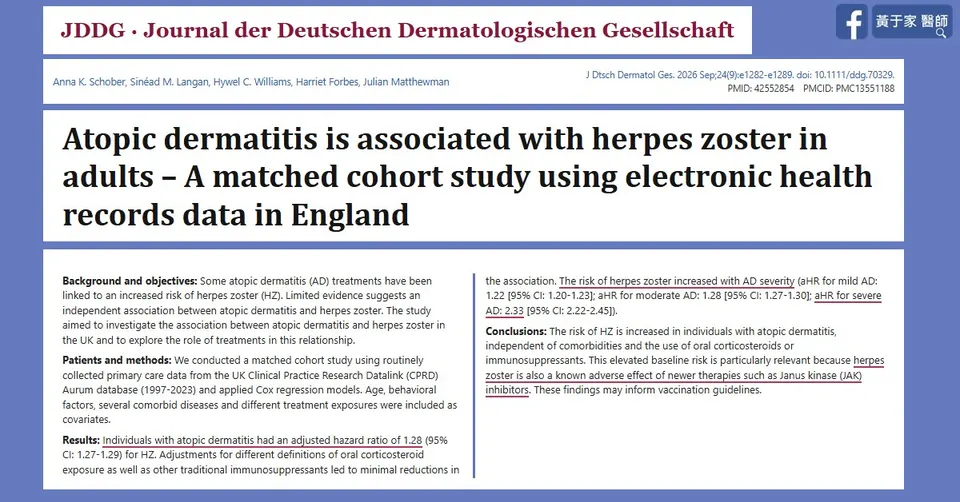
倫敦衛生與熱帶醫學院(London School of Hygiene & Tropical Medicine)、諾丁漢大學(University of Nottingham)團隊發現,異位性皮膚炎越嚴重,帶狀疱疹風險越高:輕度 1.22 倍、中度 1.28 倍、重度達 2.33 倍。
50 歲以下的患者,跟沒有異位性皮膚炎的人差距更明顯。
澳洲,近 9.5 萬位 45 歲以上成人(2021)
新南威爾斯大學(University of New South Wales)、澳洲國立大學(Australian National University)團隊發現,有使用注射或口服類固醇的患者,帶狀疱疹風險高 59%。
用量越多,風險越高;使用類固醇一個月內,風險高達 6 倍。
波蘭,11 篇研究的系統性回顧(2026)
西利西亞醫科大學(Medical University of Silesia)團隊整理 11 篇研究發現,異位性皮膚炎患者使用口服小分子藥物,例如銳虎(upadacitinib)、喜繽果(abrocitinib)、愛滅炎(baricitinib),和帶狀疱疹有關。
年紀較大、劑量較高的患者,風險較高;亞洲族群也有帶狀疱疹較多的趨勢。
研究團隊也指出,大多數個案症狀不嚴重、可以治療,很少需要因此停藥。
異位性皮膚炎本身,帶狀疱疹風險就比較高
台灣與英國的研究都發現,把用藥的影響扣除之後,異位性皮膚炎患者的帶狀疱疹風險仍然比較高。
也就是說,異位性皮膚炎本身就會讓帶狀疱疹的風險升高,不全是藥物造成的。
病情越重,用藥越多,風險越往上加
病情越重,往往需要用越多、越強的藥。
注射或口服類固醇,正是異位性皮膚炎發作時常用的治療;英國研究團隊也認為,使用口服類固醇、強效外擦類固醇和免疫抑制劑,可能會讓風險再往上加一些。
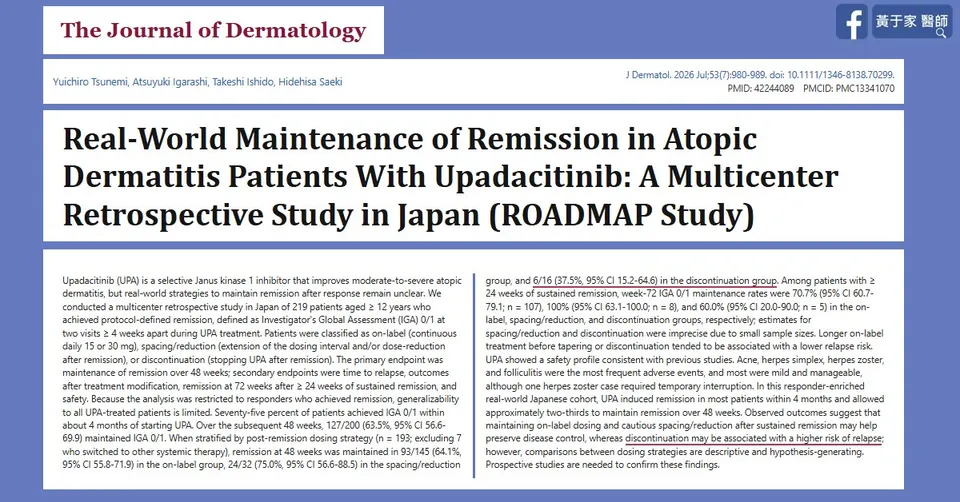
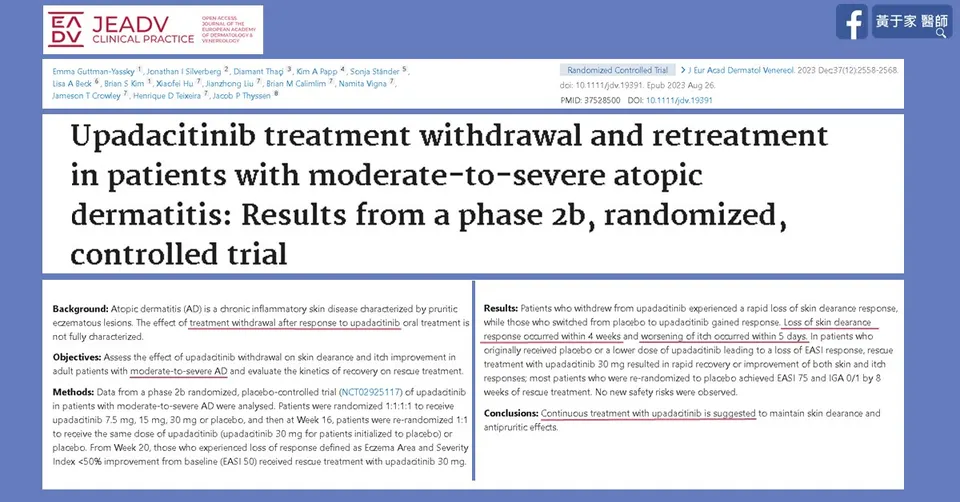
口服小分子藥物如銳虎,則是本身就會有帶狀疱疹的副作用,日本銳虎多中心研究中,帶狀疱疹就是常見的副作用之一。
異位性皮膚炎本身的帶狀疱疹風險本來就比較高,若病情反覆、需要一再使用這些藥物,風險可能又更高。
我在我看異位性皮膚炎生物製劑、小分子藥物浪潮一文中也寫過,小分子藥物會干預免疫功能,有感染風險增加、血球低下等副作用,用藥期間需要定期抽血檢查。
研究團隊的建議
英國與波蘭的研究團隊都建議,這些結果可以作為施打帶狀疱疹疫苗的參考,特別是準備使用小分子藥物的患者。
澳洲研究團隊則提醒,醫師開立類固醇要謹慎,盡量用最低的劑量、最短的療程。
我想說的
帶狀疱疹是在抵抗力變差時發作。
門診中,異位性皮膚炎患者常常因為癢而睡不好,白天疲倦、體力差,也有不少外擦、注射、口服類固醇都用過、口服類固醇、免疫抑制劑仍無法改善,或停不了銳虎的患者。
所以我治療異位性皮膚炎,不只看皮膚,也會一起照顧患者的睡眠和精神,讓病情穩定下來,減少反覆使用這些藥物的需要。
原始論文與摘要
以下依文中順序,附上四篇研究的原始論文、英文摘要與中文翻譯。中文翻譯僅供參考,內容以英文原文為準。
台灣,28,677 位異位性皮膚炎患者(2023)
Wu SE, Chen YH, Chung CH, Wu GJ, Tsao CH, Sun CA, Chien WC, Hung CT. Dermatitis. 2023;34(3):241-249. doi:10.1089/derm.2022.0094
摘要引自 PubMed,著作權屬原作者與期刊。
Background: In the wake of the emerging development of biologics in atopic dermatitis (AD), herpes zoster (HZ) infection has been reported as a treatment-related adverse event.
Objectives: This study aims at investigating the association between AD and HZ, and the risk factors within.
Methods: 28,677 participants with AD from the Taiwan National Health Insurance Research Database 2000-2015 were enrolled. Risk of HZ infection was compared in the study cohort (with AD) and the control cohort (without AD). Further analyses were conducted in gender-, age-, and treatment strategy-stratified subgroups.
Results: Significantly higher adjusted hazard ratios (aHRs) of HZ infection were revealed in AD patients (aHR = 2.303, P < 0.001), and remained this trend in gender- and age-stratified models. All AD groups, irrespective of the treatment type, had higher aHRs (AD without systemic treatment: aHR = 2.356, P < 0.001; AD with systemic treatment: aHR = 2.182, P < 0.001) compared with those without AD. However, no differences in HZ risk were shown between each treatment type.
Conclusions: Risk of HZ infection in AD is higher irrespective of treatment type. Considering that AD per se increases susceptibility to HZ infection, the administration of biologics requires careful considerations.
中文翻譯
異位性皮膚炎是帶狀疱疹感染的風險因子,與治療無關:全國性人口世代研究
背景:隨著異位性皮膚炎生物製劑陸續發展,帶狀疱疹感染已被報告為與治療相關的不良事件。
目的:本研究探討異位性皮膚炎與帶狀疱疹之間的關聯,以及其中的風險因子。
方法:從台灣全民健康保險研究資料庫納入 2000 至 2015 年間 28,677 位異位性皮膚炎患者,比較研究組(有異位性皮膚炎)與對照組(沒有異位性皮膚炎)發生帶狀疱疹的風險,並依性別、年齡與治療方式分組進一步分析。
結果:異位性皮膚炎患者發生帶狀疱疹的校正風險比明顯較高(2.303,P < 0.001),依性別與年齡分層後仍維持此趨勢。不論治療方式,所有異位性皮膚炎組的風險都高於沒有異位性皮膚炎者(未使用全身性治療:校正風險比 2.356,P < 0.001;使用全身性治療:校正風險比 2.182,P < 0.001),但各種治療方式之間的帶狀疱疹風險沒有差異。
結論:不論治療方式,異位性皮膚炎患者感染帶狀疱疹的風險都較高。由於異位性皮膚炎本身就會增加對帶狀疱疹的易感性,使用生物製劑時需要審慎考量。
英國,約 1,300 萬位成人(2026)
Schober AK, Langan SM, Williams HC, Forbes H, Matthewman J. Journal der Deutschen Dermatologischen Gesellschaft. 2026;24(9):e1282-e1289. doi:10.1111/ddg.70329
本文摘要依 CC BY 4.0 授權轉載,著作權屬原作者。
Background and objectives: Some atopic dermatitis (AD) treatments have been linked to an increased risk of herpes zoster (HZ). Limited evidence suggests an independent association between atopic dermatitis and herpes zoster. The study aimed to investigate the association between atopic dermatitis and herpes zoster in the UK and to explore the role of treatments in this relationship.
Patients and methods: We conducted a matched cohort study using routinely collected primary care data from the UK Clinical Practice Research Datalink (CPRD) Aurum database (1997-2023) and applied Cox regression models. Age, behavioral factors, several comorbid diseases and different treatment exposures were included as covariates.
Results: Individuals with atopic dermatitis had an adjusted hazard ratio of 1.28 (95% CI: 1.27-1.29) for HZ. Adjustments for different definitions of oral corticosteroid exposure as well as other traditional immunosuppressants led to minimal reductions in the association. The risk of herpes zoster increased with AD severity (aHR for mild AD: 1.22 [95% CI: 1.20-1.23]; aHR for moderate AD: 1.28 [95% CI: 1.27-1.30]; aHR for severe AD: 2.33 [95% CI: 2.22-2.45]).
Conclusions: The risk of HZ is increased in individuals with atopic dermatitis, independent of comorbidities and the use of oral corticosteroids or immunosuppressants. This elevated baseline risk is particularly relevant because herpes zoster is also a known adverse effect of newer therapies such as Janus kinase (JAK) inhibitors. These findings may inform vaccination guidelines.
中文翻譯
成人異位性皮膚炎與帶狀疱疹有關:以英格蘭電子病歷資料進行的配對世代研究
背景與目的:部分異位性皮膚炎的治療藥物,與帶狀疱疹風險增加有關。有限的證據顯示,異位性皮膚炎與帶狀疱疹之間可能有獨立的關聯。本研究目的是探討英國異位性皮膚炎與帶狀疱疹的關聯,並探討治療藥物在其中扮演的角色。
患者與方法:我們使用英國臨床實務研究資料庫(CPRD)Aurum 的基層醫療例行資料(1997 至 2023 年)進行配對世代研究,並以 Cox 迴歸模型分析。年齡、行為因素、多種共病,以及不同的治療藥物暴露,都納入校正。
結果:異位性皮膚炎患者發生帶狀疱疹的校正風險比為 1.28(95% 信賴區間 1.27–1.29)。以不同方式定義口服類固醇暴露,以及校正其他傳統免疫抑制劑後,這個關聯只略為降低。帶狀疱疹風險隨異位性皮膚炎嚴重度增加而升高(輕度校正風險比 1.22[95% 信賴區間 1.20–1.23];中度 1.28[1.27–1.30];重度 2.33[2.22–2.45])。
結論:異位性皮膚炎患者的帶狀疱疹風險較高,且不受共病及口服類固醇或免疫抑制劑使用的影響。這個本來就偏高的風險特別值得重視,因為帶狀疱疹也是 JAK 抑制劑等新藥已知的副作用。這些發現可作為疫苗接種建議的參考。
澳洲,近 9.5 萬位 45 歲以上成人(2021)
Corticosteroid Use and Risk of Herpes Zoster in a Population-Based Cohort(外部網站)
Qian J, Banks E, Macartney K, Heywood AE, Lassere MN, Liu B. Mayo Clinic Proceedings. 2021;96(11):2843-2853. doi:10.1016/j.mayocp.2021.05.029
摘要引自 PubMed,著作權屬原作者與期刊。
Objective: To examine the relationship between corticosteroid use and herpes zoster risk.
Methods: With data from a large cohort of adults (the 45 and Up Study) recruited between 2006 and 2009 and linked to health data sets, the effect of corticosteroid use on zoster risk was analyzed by Cox proportional hazards models, adjusting for age, sex, and other characteristics.
Results: During 602,152 person-years (median, 7.36 years) of follow-up, there were 20,048 new systemic corticosteroid users and 6294 incident herpes zoster events among 94,677 participants (zoster incidence, 11.0 per 1000 person-years). Compared with nonusers, the risk of zoster was 59% higher in those using systemic corticosteroids (adjusted hazard ratio [aHR], 1.59; 95% CI, 1.48 to 1.71) and greater with higher cumulative doses: aHR of 1.32 (95% CI, 1.17 to 1.48), 1.74 (95% CI, 1.55 to 1.95), and 1.80 (95% CI, 1.61 to 2.02) for use of less than 500 mg, 500 mg to less than 1000 mg, and 1000 mg or more prednisolone equivalents, respectively (P value for trend, <.001). Compared with nonusers, zoster risk increased significantly (aHR, 6.00; 95% CI, 4.85 to 7.42) in the month after a single prescription of systemic corticosteroids and returned to levels similar to those in nonusers by the third month after dispensing (aHR, 0.91; 95% CI, 0.49 to 1.69).
Conclusion: Practitioners should be alert to the increased risk of zoster among patients taking systemic corticosteroids. Given the significant morbidity from zoster, particularly in older adults, these findings support judicious prescribing of corticosteroids, including using as low a dose and as short a course as possible.
中文翻譯
在一般族群世代中,類固醇使用與帶狀疱疹風險
目的:探討類固醇使用與帶狀疱疹風險之間的關係。
方法:使用一個大型成人世代(45 and Up 研究,2006 至 2009 年招募)並串連健康資料庫,以 Cox 比例風險模型分析類固醇使用對帶狀疱疹風險的影響,並校正年齡、性別及其他特徵。
結果:94,677 位參與者共追蹤 602,152 人年(中位數 7.36 年),期間有 20,048 位新的全身性類固醇使用者,發生 6,294 例帶狀疱疹(發生率每 1,000 人年 11.0 例)。與未使用者相比,使用全身性類固醇者的帶狀疱疹風險高 59%(校正風險比 1.59;95% 信賴區間 1.48–1.71),且累積劑量越高風險越高:累積劑量少於 500 毫克、500 至未滿 1,000 毫克、1,000 毫克以上(以 prednisolone 等效劑量計)的校正風險比分別為 1.32(1.17–1.48)、1.74(1.55–1.95)與 1.80(1.61–2.02)(趨勢檢定 P < .001)。與未使用者相比,單次領取全身性類固醇處方後的一個月內,帶狀疱疹風險明顯升高(校正風險比 6.00;95% 信賴區間 4.85–7.42),到領藥後第三個月回到與未使用者相近的程度(校正風險比 0.91;95% 信賴區間 0.49–1.69)。
結論:醫師應留意使用全身性類固醇的患者,帶狀疱疹風險會增加。由於帶狀疱疹會造成相當的病痛,特別是年長者,這些發現支持審慎開立類固醇,包括盡量使用最低劑量與最短療程。
波蘭,11 篇研究的系統性回顧(2026)
Mandecka A, Perlak K, Bajek W, Kruczek W, Frątczak A, Polak K, Miziołek B, Bergler-Czop B. Clinical and Translational Science. 2026;19(3):e70513. doi:10.1111/cts.70513
本文摘要依 CC BY-NC-ND 4.0 授權轉載,著作權屬原作者。
Atopic dermatitis (AD) is a chronic inflammatory skin disease that markedly impairs quality of life. Janus kinase inhibitors (upadacitinib, abrocitinib, and baricitinib) are effective therapies for moderate-to-severe AD but are associated with viral reactivation, particularly herpes zoster (HZ), due to immunosuppressive effects on interferon signaling and natural killer cell activity. The objective of this study was to systematically evaluate the risk of HZ among AD patients treated with JAK inhibitors (JAKis), identify key risk factors, and assess the clinical outcomes and management of HZ in this population. A systematic review of PubMed, Embase, and the Cochrane Library evaluated HZ risk in adolescents and adults with moderate-to-severe AD treated with JAK. Searches followed PRISMA guidelines using MeSH and EMTREE terms. The protocol was registered in PROSPERO (CRD420251070483). Eligible English-language studies included randomized trials, cohort studies, pooled safety analyses, and case series with ≥ 5 participants; reviews, case reports, and pediatric, animal, or in vitro studies were excluded. Data extraction was performed independently by two reviewers. The certainty of evidence was assessed using the GRADE approach. Eleven studies were included. The risk of HZ incidence appears higher in older patients. In some cases, the risk correlates with higher doses of JAK inhibitors, and a trend toward increased HZ events has been observed in Asian populations. HZ is a relevant but generally manageable adverse event in AD patients on JAKis. Risk stratification by age, dose, and comorbidities is advised. Ongoing real-world monitoring is crucial for optimizing outcomes.
中文翻譯
以 JAK 抑制劑治療的異位性皮膚炎患者發生帶狀疱疹之回顧
異位性皮膚炎是一種會明顯影響生活品質的慢性發炎性皮膚病。JAK 抑制劑(upadacitinib〔銳虎〕、abrocitinib〔喜繽果〕、baricitinib〔愛滅炎〕)是治療中重度異位性皮膚炎的有效藥物,但因為會抑制干擾素訊號與自然殺手細胞的活性,與病毒再活化有關,特別是帶狀疱疹。本研究目的是系統性評估使用 JAK 抑制劑的異位性皮膚炎患者發生帶狀疱疹的風險、找出主要危險因子,並評估帶狀疱疹的臨床結果與處置。研究檢索 PubMed、Embase 與 Cochrane 圖書館,評估使用 JAK 抑制劑的青少年與成人中重度異位性皮膚炎患者的帶狀疱疹風險,依 PRISMA 指引進行,並於 PROSPERO 登錄(CRD420251070483)。納入的英文研究包括隨機試驗、世代研究、合併安全性分析,以及 5 人以上的病例系列;排除回顧文章、個案報告、兒童、動物與體外研究。資料由兩位審查者各自獨立擷取,並以 GRADE 方法評估證據確定性。共納入 11 篇研究。年紀較大的患者,帶狀疱疹發生風險似乎較高;部分研究中,風險與 JAK 抑制劑劑量較高有關;在亞洲族群中也觀察到帶狀疱疹較多的趨勢。帶狀疱疹是使用 JAK 抑制劑的異位性皮膚炎患者需要重視、但通常可以處理的副作用。建議依年齡、劑量與共病進行風險分層,並持續進行真實世界的監測。
相關治療紀錄
- 異位性皮膚炎,類固醇外擦、注射、口服無法改善,皮膚紅乾劇癢,難眠
- 異位性皮膚炎,口服類固醇、免疫抑制劑、抗組織胺,皮膚紅乾癢甚,無法安睡
- 異位性皮膚炎,停不了的銳虎 RINVOQ
- 異位性皮膚炎,乾燥搔抓無法入睡,體重直落
- 異位性皮膚炎,中醫經方的治療實例