異位性皮膚炎患者口服小分子藥物銳虎,穩定後停藥,有超過六成患者會復發 - 日本多中心研究
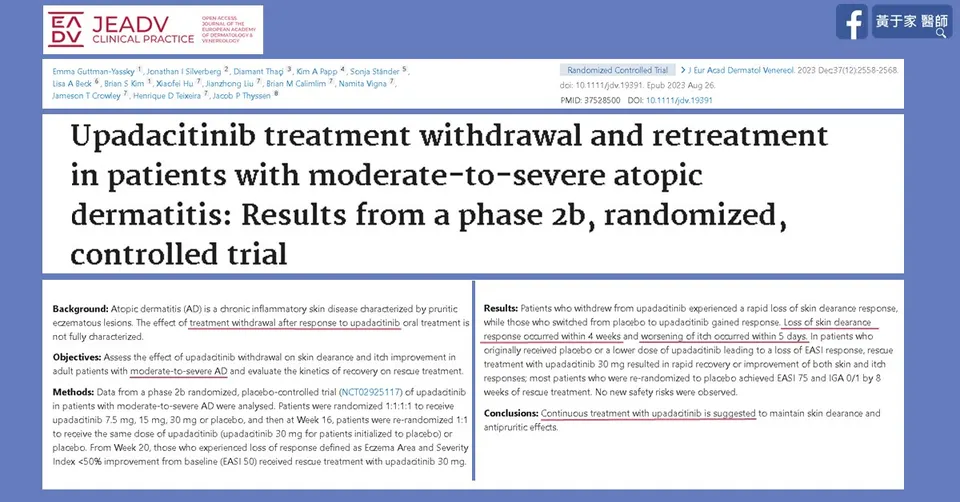
之前整理過銳虎無法停,一停藥就會迅速復發的研究,這次是日本的多中心研究,觀察 219 位使用銳虎(upadacitinib)達到緩解的異位性皮膚炎患者。
每個人吃銳虎到病情穩定(皮膚幾乎全好)的時間不一樣,中位數大約 12 週;研究從每個人穩定的那天開始,各自往後追蹤 48 週,看病情能不能維持。
病情穩定之後,患者分成三種做法:繼續照原本劑量吃(145 人)、減量或隔天吃(32 人)、停藥(16 人),每個人停藥的時間點不同。
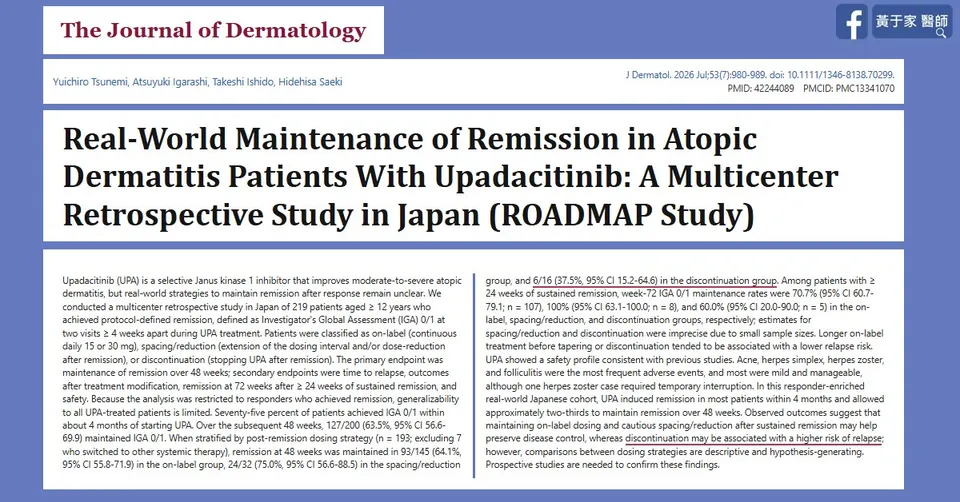
停藥的 16 人中,有 10 人復發(62.5%,超過六成),只有 6 人(37.5%)維持穩定;繼續照原本劑量吃的人,約六成四維持穩定。
這裡停的是銳虎。研究開始時,有 89% 的患者同時在擦外用藥,其中八成是類固醇藥膏;停用銳虎之後是否還繼續擦,論文沒有分開說明。
作者的建議是:緩解後繼續吃藥,或謹慎地減量、拉長服藥間隔。
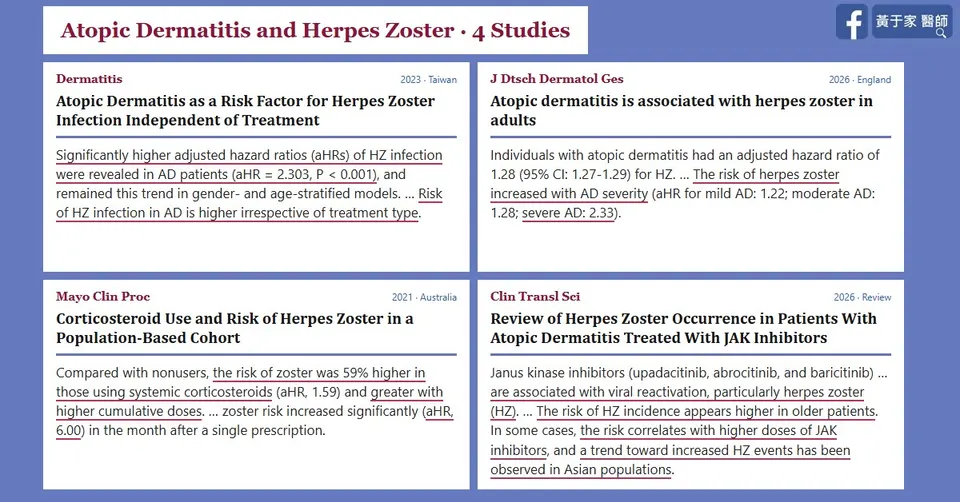
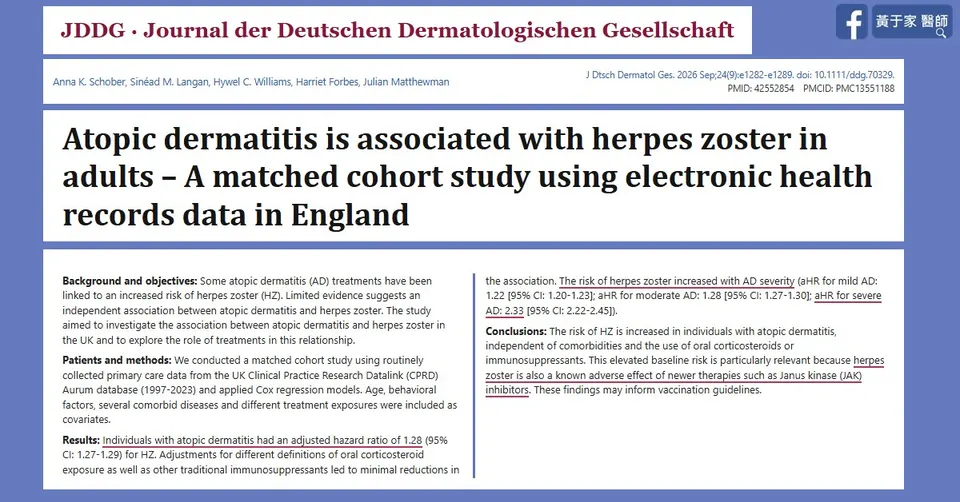
常見的副作用則包括痤瘡、單純疱疹、帶狀疱疹與毛囊炎。
這與我在中醫師診間觀察:我看異位性皮膚炎生物製劑、小分子藥物浪潮寫過的門診所見一致:患者往往也得一直施打或服用這些藥,因為一減藥狀況就沒那麼好,一停藥就會復發。
門診也有停不了銳虎、銳虎一停就惡化才來求診的異位性皮膚炎患者。
口服 JAK 抑制劑見效快,但很多患者面臨的是「要吃多久?能不能停?」的問題。
我在意的,是患者治療結束之後的生活,就像我在離開醫院第十年那篇寫的,我更常多問一句:「停藥之後呢?」
本篇研究,“Real-World Maintenance of Remission in Atopic Dermatitis Patients With Upadacitinib: A Multicenter Retrospective Study in Japan (ROADMAP Study)”,期刊摘要如下:
Upadacitinib (UPA) is a selective Janus kinase 1 inhibitor that improves moderate-to-severe atopic dermatitis, but real-world strategies to maintain remission after response remain unclear.
We conducted a multicenter retrospective study in Japan of 219 patients aged ≥ 12 years who achieved protocol-defined remission, defined as Investigator’s Global Assessment (IGA) 0/1 at two visits ≥ 4 weeks apart during UPA treatment. Patients were classified as on-label (continuous daily 15 or 30 mg), spacing/reduction (extension of the dosing interval and/or dose-reduction after remission), or discontinuation (stopping UPA after remission). The primary endpoint was maintenance of remission over 48 weeks; secondary endpoints were time to relapse, outcomes after treatment modification, remission at 72 weeks after ≥ 24 weeks of sustained remission, and safety. Because the analysis was restricted to responders who achieved remission, generalizability to all UPA-treated patients is limited.
Seventy-five percent of patients achieved IGA 0/1 within about 4 months of starting UPA. Over the subsequent 48 weeks, 127/200 (63.5%, 95% CI 56.6-69.9) maintained IGA 0/1. When stratified by post-remission dosing strategy (n = 193; excluding 7 who switched to other systemic therapy), remission at 48 weeks was maintained in 93/145 (64.1%, 95% CI 55.8-71.9) in the on-label group, 24/32 (75.0%, 95% CI 56.6-88.5) in the spacing/reduction group, and 6/16 (37.5%, 95% CI 15.2-64.6) in the discontinuation group. Among patients with ≥ 24 weeks of sustained remission, week-72 IGA 0/1 maintenance rates were 70.7% (95% CI 60.7-79.1; n = 107), 100% (95% CI 63.1-100.0; n = 8), and 60.0% (95% CI 20.0-90.0; n = 5) in the on-label, spacing/reduction, and discontinuation groups, respectively; estimates for spacing/reduction and discontinuation were imprecise due to small sample sizes. Longer on-label treatment before tapering or discontinuation tended to be associated with a lower relapse risk.
UPA showed a safety profile consistent with previous studies. Acne, herpes simplex, herpes zoster, and folliculitis were the most frequent adverse events, and most were mild and manageable, although one herpes zoster case required temporary interruption.
In this responder-enriched real-world Japanese cohort, UPA induced remission in most patients within 4 months and allowed approximately two-thirds to maintain remission over 48 weeks. Observed outcomes suggest that maintaining on-label dosing and cautious spacing/reduction after sustained remission may help preserve disease control, whereas discontinuation may be associated with a higher risk of relapse; however, comparisons between dosing strategies are descriptive and hypothesis-generating. Prospective studies are needed to confirm these findings.
原始論文
Tsunemi Y, Igarashi A, Ishido T, Saeki H. The Journal of Dermatology. 2026;53(7):980-989. doi:10.1111/1346-8138.70299
本文摘要依 CC BY 4.0 授權轉載,著作權屬原作者。
論文摘要(中文翻譯)
以下為中文翻譯,僅供參考,內容以英文原文為準。
異位性皮膚炎患者使用 upadacitinib 後的真實世界緩解維持:日本多中心回溯性研究(ROADMAP 研究)
Upadacitinib(UPA,商品名銳虎)是選擇性 JAK1 抑制劑,可改善中重度異位性皮膚炎,但在真實世界中,治療有反應後該如何維持緩解,目前仍不清楚。
我們在日本進行多中心回溯性研究,納入 219 位 12 歲以上、在 UPA 治療期間達到研究定義之緩解(間隔 4 週以上的兩次回診,研究者整體評估 IGA 皆為 0 或 1)的患者。患者分為三組:標準用法組(每天持續服用 15 或 30 mg)、延長間隔或減量組(緩解後拉長服藥間隔和/或降低劑量),以及停藥組(緩解後停用 UPA)。主要指標是 48 週內能否維持緩解;次要指標包括復發所需時間、調整治療後的結果、持續緩解 24 週以上者在第 72 週的緩解情形,以及安全性。由於分析只納入已達緩解的患者,結果不一定適用於所有使用 UPA 的患者。
75% 的患者在開始服用 UPA 約 4 個月內達到 IGA 0 或 1。在之後的 48 週,200 人中有 127 人(63.5%,95% 信賴區間 56.6–69.9)維持 IGA 0 或 1。依緩解後的用藥方式分組(193 人;排除 7 位改用其他全身性治療者),48 週時維持緩解的比例為:標準用法組 145 人中 93 人(64.1%,95% CI 55.8–71.9)、延長間隔或減量組 32 人中 24 人(75.0%,95% CI 56.6–88.5)、停藥組 16 人中 6 人(37.5%,95% CI 15.2–64.6)。在持續緩解 24 週以上的患者中,第 72 週維持 IGA 0 或 1 的比例,標準用法組、延長間隔或減量組與停藥組分別為 70.7%(95% CI 60.7–79.1;107 人)、100%(95% CI 63.1–100.0;8 人)與 60.0%(95% CI 20.0–90.0;5 人);後兩組人數少,估計值不夠精確。在減量或停藥前,以標準用法治療越久,復發風險有越低的趨勢。
UPA 的安全性與過去研究一致。最常見的不良事件是痤瘡、單純疱疹、帶狀疱疹與毛囊炎,大多輕微且可處理,但有一例帶狀疱疹需要暫時停藥。
在這個以治療有反應者為主的日本真實世界族群中,大多數患者在 4 個月內因 UPA 達到緩解,約三分之二能在 48 週內維持緩解。觀察結果顯示,持續緩解後維持標準用法,或謹慎地延長間隔、減量,可能有助於維持病情控制;停藥則可能與較高的復發風險有關。不過,各種用藥方式之間的比較屬於描述性質,只能作為假說,仍需前瞻性研究確認。
相關治療紀錄
- 異位性皮膚炎,停不了的銳虎 RINVOQ
- 異位性皮膚炎,手部濕疹,銳虎一停就惡化
- 擔心停藥就會打回原形?異位性皮膚炎,停中藥一年後的現況追蹤
- 異位性皮膚炎,多年,停中藥二年後的現況追蹤
- 諸多患者停服中藥後的實況追蹤