異位性皮膚炎與甜食攝取有關,青少年吃越多添加糖,有異位性皮膚炎的比例會越高 - 英國研究
門診常有家長問我:孩子是不是不能吃甜的?
這篇英國研究,追蹤 5,372 位兒童從出生到 13 歲的飲食。
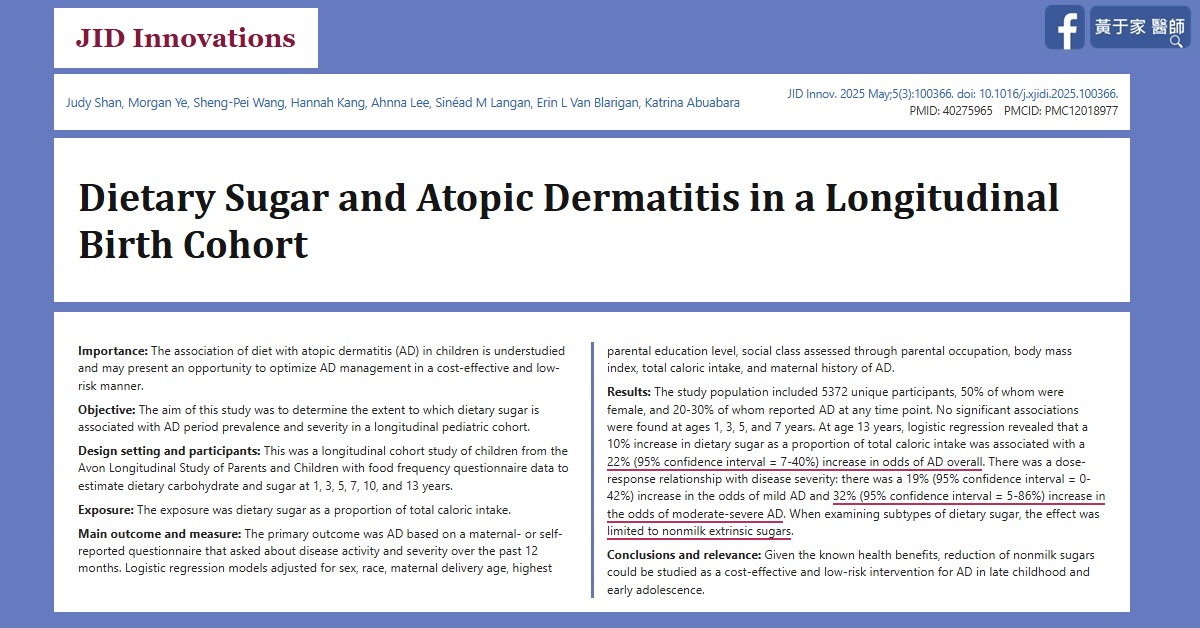
1 到 10 歲時看不出關聯,但到了 13 歲左右的青春期,糖佔總熱量的比例每多 10%,有異位性皮膚炎的機率多 22%,中重度的機率多 32%。
要注意的是,研究比較的是同年齡的孩子「有沒有」異位性皮膚炎,並不是追蹤原本就有異位的孩子,看糖吃多了病情會不會變嚴重。
值得注意的是,有關聯的是添加糖(手搖飲、果汁、甜點等食物裡加進去的糖);牛奶本身的乳糖則沒有關聯。
我在 2019 年的丹羽療法就真的萬無一失?也寫過,臨床上觀察到甜食的確會讓皮膚病灶惡化。
所以不需要全部戒糖,從減少手搖飲和甜點開始就好。
飲食調整是輔助,皮膚的治療還是要持續。
本篇研究,“Dietary Sugar and Atopic Dermatitis in a Longitudinal Birth Cohort”,期刊摘要如下:
Importance
The association of diet with atopic dermatitis (AD) in children is understudied and may present an opportunity to optimize AD management in a cost-effective and low-risk manner.
Objective
The aim of this study was to determine the extent to which dietary sugar is associated with AD period prevalence and severity in a longitudinal pediatric cohort.
Design, Setting, and Participants
This was a longitudinal cohort study of children from the Avon Longitudinal Study of Parents and Children with food frequency questionnaire data to estimate dietary carbohydrate and sugar at 1, 3, 5, 7, 10, and 13 years.
Exposure
The exposure was dietary sugar as a proportion of total caloric intake.
Main Outcome and Measure
The primary outcome was AD based on a maternal- or self-reported questionnaire that asked about disease activity and severity over the past 12 months. Logistic regression models adjusted for sex, race, maternal delivery age, highest parental education level, social class assessed through parental occupation, body mass index, total caloric intake, and maternal history of AD.
Results
The study population included 5372 unique participants, 50% of whom were female, and 20-30% of whom reported AD at any time point. No significant associations were found at ages 1, 3, 5, and 7 years. At age 13 years, logistic regression revealed that a 10% increase in dietary sugar as a proportion of total caloric intake was associated with a 22% (95% confidence interval = 7-40%) increase in odds of AD overall. There was a dose-response relationship with disease severity: there was a 19% (95% confidence interval = 0-42%) increase in the odds of mild AD and 32% (95% confidence interval = 5-86%) increase in the odds of moderate-severe AD. When examining subtypes of dietary sugar, the effect was limited to nonmilk extrinsic sugars.
Conclusions and Relevance
Given the known health benefits, reduction of nonmilk sugars could be studied as a cost-effective and low-risk intervention for AD in late childhood and early adolescence.
原始論文
Dietary Sugar and Atopic Dermatitis in a Longitudinal Birth Cohort(外部網站)
Shan J, Ye M, Wang SP, Kang H, Lee A, Langan SM, Van Blarigan EL, Abuabara K. JID Innovations. 2025;5(3):100366. doi:10.1016/j.xjidi.2025.100366
本文摘要依 CC BY-NC-ND 4.0 授權轉載,著作權屬原作者。
論文摘要(中文翻譯)
以下為中文翻譯,僅供參考,內容以英文原文為準。
飲食中的糖與異位性皮膚炎:長期追蹤的出生世代研究
重要性:兒童飲食與異位性皮膚炎的關係研究不多,若能釐清,可能成為成本低、風險小的異位性皮膚炎照護方式。
目的:在長期追蹤的兒童世代中,探討飲食中的糖與異位性皮膚炎盛行率及嚴重度的關聯程度。
研究設計、場域與對象:本研究為長期世代研究,對象是英國「雅芳親子縱貫研究」(ALSPAC)的兒童,以食物頻率問卷估算他們在 1、3、5、7、10、13 歲時飲食中的碳水化合物與糖攝取量。
暴露因子:飲食中的糖佔總熱量的比例。
主要結果與測量方式:主要結果為異位性皮膚炎,依母親填寫或本人自填的問卷判定,問卷詢問過去 12 個月的病情活動度與嚴重度。邏輯斯迴歸模型校正了性別、種族、母親生產年齡、父母最高教育程度、以父母職業評估的社會階層、身體質量指數(BMI)、總熱量攝取,以及母親是否有異位性皮膚炎病史。
結果:共納入 5372 位參與者,其中 50% 為女性,各時間點有 20–30% 的人回報有異位性皮膚炎。1、3、5、7 歲時,糖攝取與異位性皮膚炎沒有明顯關聯。到了 13 歲,糖佔總熱量的比例每增加 10%,有異位性皮膚炎的機率增加 22%(95% 信賴區間 7–40%)。這個關聯與病情嚴重度呈劑量反應關係:輕度異位性皮膚炎的機率增加 19%(95% 信賴區間 0–42%),中重度增加 32%(95% 信賴區間 5–86%)。進一步區分糖的種類後發現,關聯只出現在「非乳源的外加糖」(nonmilk extrinsic sugars,即牛奶本身乳糖以外、額外添加或來自果汁等的糖)。
結論與意義:減少非乳源的糖本身已知有益健康,可以進一步研究,作為青春期前後兒童異位性皮膚炎低成本、低風險的介入方式。