過多鹽分攝取會增加異位性皮膚炎的發生嗎?英國研究:鈉攝取過多會導致膚況惡化及異位性皮膚炎更頻繁發作
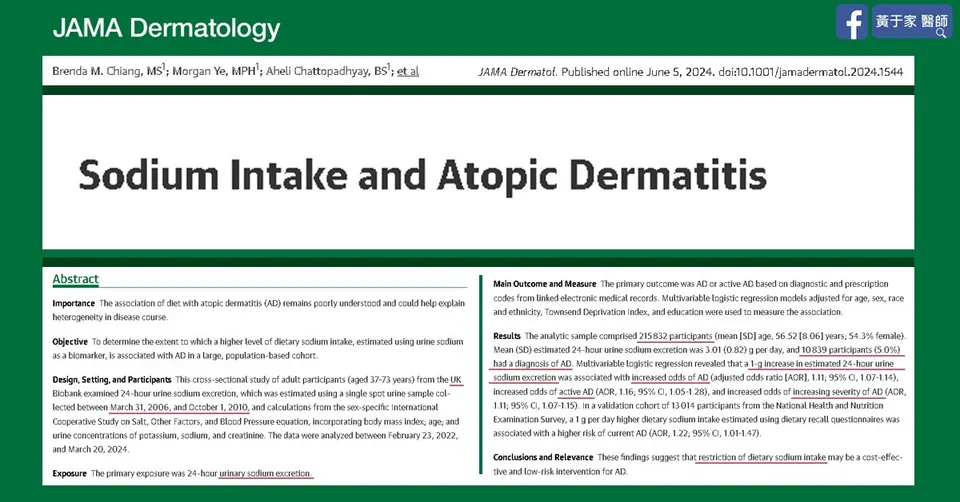
本篇研究,Sodium Intake and Atopic Dermatitis,請見這裡(外部網站)。
Importance
The association of diet with atopic dermatitis (AD) remains poorly understood and could help explain heterogeneity in disease course.
Objective
To determine the extent to which a higher level of dietary sodium intake, estimated using urine sodium as a biomarker, is associated with AD in a large, population-based cohort.
Design, Setting, and Participants
This cross-sectional study of adult participants (aged 37-73 years) from the UK Biobank examined 24-hour urine sodium excretion, which was estimated using a single spot urine sample collected between March 31, 2006, and October 1, 2010, and calculations from the sex-specific International Cooperative Study on Salt, Other Factors, and Blood Pressure equation, incorporating body mass index; age; and urine concentrations of potassium, sodium, and creatinine. The data were analyzed between February 23, 2022, and March 20, 2024.
Exposure
The primary exposure was 24-hour urinary sodium excretion.
Main Outcome and Measure
The primary outcome was AD or active AD based on diagnostic and prescription codes from linked electronic medical records. Multivariable logistic regression models adjusted for age, sex, race and ethnicity, Townsend Deprivation Index, and education were used to measure the association.
Results
The analytic sample comprised 215 832 participants (mean [SD] age, 56.52 [8.06] years; 54.3% female). Mean (SD) estimated 24-hour urine sodium excretion was 3.01 (0.82) g per day, and 10 839 participants (5.0%) had a diagnosis of AD. Multivariable logistic regression revealed that a 1-g increase in estimated 24-hour urine sodium excretion was associated with increased odds of AD (adjusted odds ratio [AOR], 1.11; 95% CI, 1.07-1.14), increased odds of active AD (AOR, 1.16; 95% CI, 1.05-1.28), and increased odds of increasing severity of AD (AOR, 1.11; 95% CI, 1.07-1.15). In a validation cohort of 13 014 participants from the National Health and Nutrition Examination Survey, a 1 g per day higher dietary sodium intake estimated using dietary recall questionnaires was associated with a higher risk of current AD (AOR, 1.22; 95% CI, 1.01-1.47).
Conclusions and Relevance
These findings suggest that restriction of dietary sodium intake may be a cost-effective and low-risk intervention for AD.
原始論文
Sodium Intake and Atopic Dermatitis(外部網站)
Chiang BM, Ye M, Chattopadhyay A, Halezeroglu Y, et al. JAMA Dermatology. 2024;160(7):725-731. doi:10.1001/jamadermatol.2024.1544
論文摘要(Google 翻譯)
以下為 Google 翻譯,並校正明顯錯誤,僅供參考,內容以英文原文為準。
鈉攝取與異位性皮膚炎
重要性:飲食與異位性皮膚炎(AD)的關聯仍所知甚少,而釐清這點可能有助於解釋病程的異質性。
目的:在一個大型族群世代中,以尿鈉作為生物標記估計飲食鈉攝取量,判定較高的鈉攝取與 AD 的關聯程度。
設計、場域與參與者:這項橫斷面研究以英國生物資料庫(UK Biobank)的成年參與者(37–73 歲)為對象,檢視其 24 小時尿鈉排泄量;此數值是以 2006 年 3 月 31 日至 2010 年 10 月 1 日間收集的單次隨機尿液樣本,依性別區分的「鹽、其他因素與血壓國際合作研究」公式計算估計,公式納入身體質量指數、年齡,以及尿液中的鉀、鈉與肌酸酐濃度。資料分析期間為 2022 年 2 月 23 日至 2024 年 3 月 20 日。
暴露因子:主要暴露因子為 24 小時尿鈉排泄量。
主要結果與測量指標:主要結果為依據連結之電子病歷中的診斷與處方代碼所認定的 AD 或活動性 AD。以校正年齡、性別、種族與族裔、Townsend 剝奪指數及教育程度的多變項邏輯斯迴歸模型評估關聯。
結果:分析樣本共 215,832 名參與者(平均[SD]年齡 56.52[8.06]歲;54.3% 為女性)。估計 24 小時尿鈉排泄量平均(SD)為每天 3.01(0.82)公克,10,839 名參與者(5.0%)有 AD 診斷。多變項邏輯斯迴歸顯示,估計 24 小時尿鈉排泄量每增加 1 公克,罹患 AD 的勝算增加(校正勝算比[AOR]1.11;95% CI 1.07–1.14),活動性 AD 的勝算增加(AOR 1.16;95% CI 1.05–1.28),AD 嚴重度上升的勝算也增加(AOR 1.11;95% CI 1.07–1.15)。在國家健康與營養檢查調查 13,014 名參與者的驗證世代中,以飲食回憶問卷估計的飲食鈉攝取量每天多 1 公克,與目前患有 AD 的風險較高相關(AOR 1.22;95% CI 1.01–1.47)。
結論與意義:這些結果顯示,限制飲食鈉攝取可能是一種符合成本效益且低風險的 AD 介入措施。
異位性皮膚炎,中醫經方的治療實例,請見這裡。
異位性皮膚炎,期刊研究,請看這裡。
期刊研究整理,請見這裡。
接下來讀這幾篇
原文發表於 作者部落格(舊部落格)。