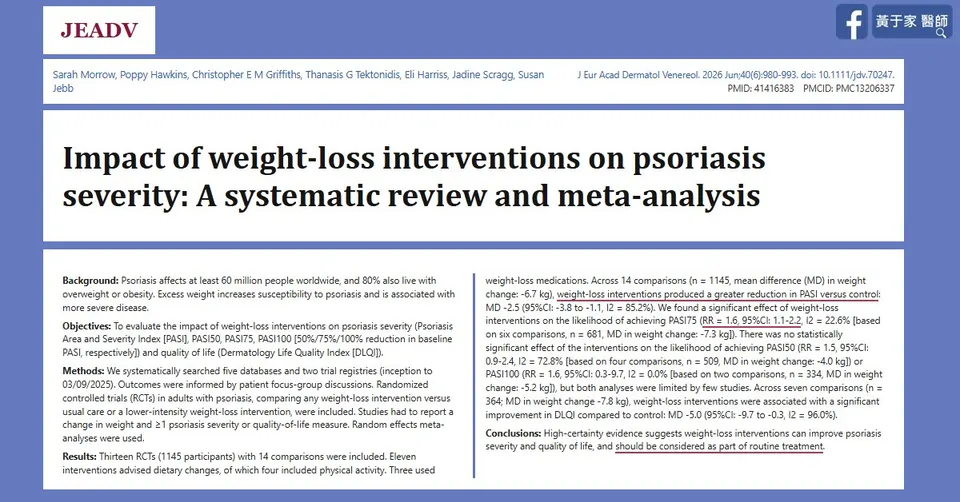
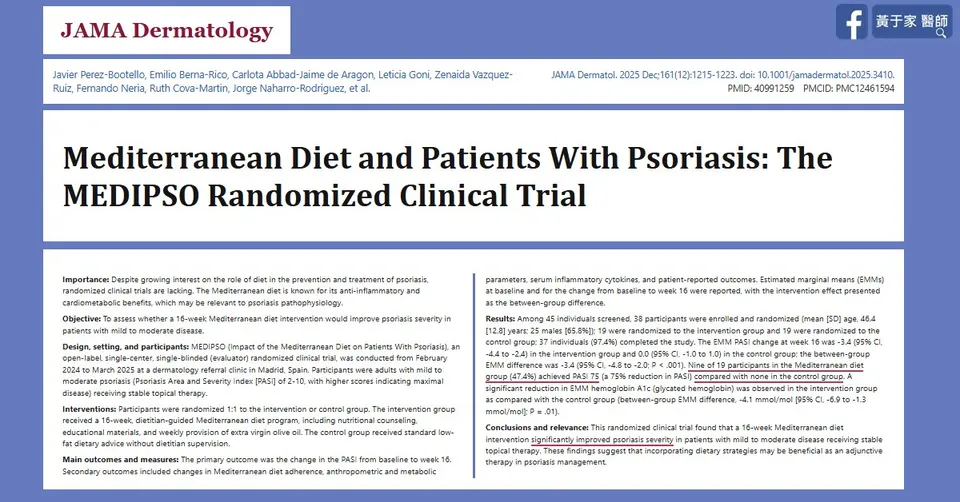
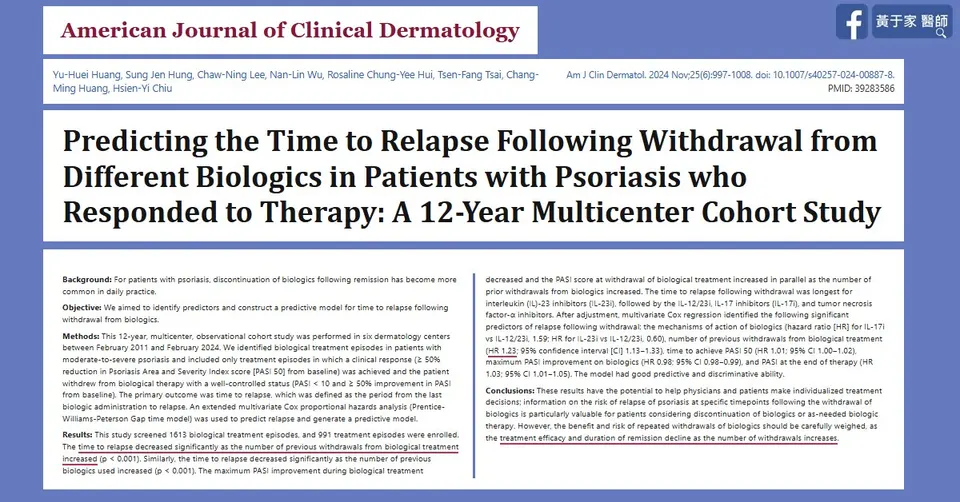
乾癬與睡眠品質密切相關,睡眠品質差會顯著升高乾癬風險,女性甚至達到 2 倍 - 英國 50 萬人研究
門診時我常提醒患者:要早點睡、睡飽。
這篇英國 50 萬人的研究,從早睡早起或晚睡晚起、睡眠時間、失眠、打鼾、白天嗜睡來評估睡眠型態。
結果發現,睡眠品質差的人(研究綜合評估晚睡晚起、睡太少或太多、失眠、打鼾、白天嗜睡這五項,不理想的項目越多,睡眠品質越差),之後得乾癬的風險是睡眠品質理想者的 1.66 倍,女性更達 2.05 倍。
天生遺傳風險高、睡眠品質又差的人,風險更是高達 3.62 倍。
我曾經從睡眠著手治療乾癬:一位多年完全沒有睡意的乾癬患者,我認為她不尋常的睡眠狀態才是乾癬的真正元凶,服藥三周時,已經一個禮拜每天都有睡。
另一位臉部乾癬的患者,多年凌晨十二點就會自動驚醒,服中醫經方 2 周後,可以一覺到天亮。
我認為基因就像種子一樣,我們無法改變基因,但我們可以改變土壤。
睡眠,就是我們每天都能照顧的土壤。
治療不是只靠醫師,患者自身也要在飲食、情緒、作息上下功夫。
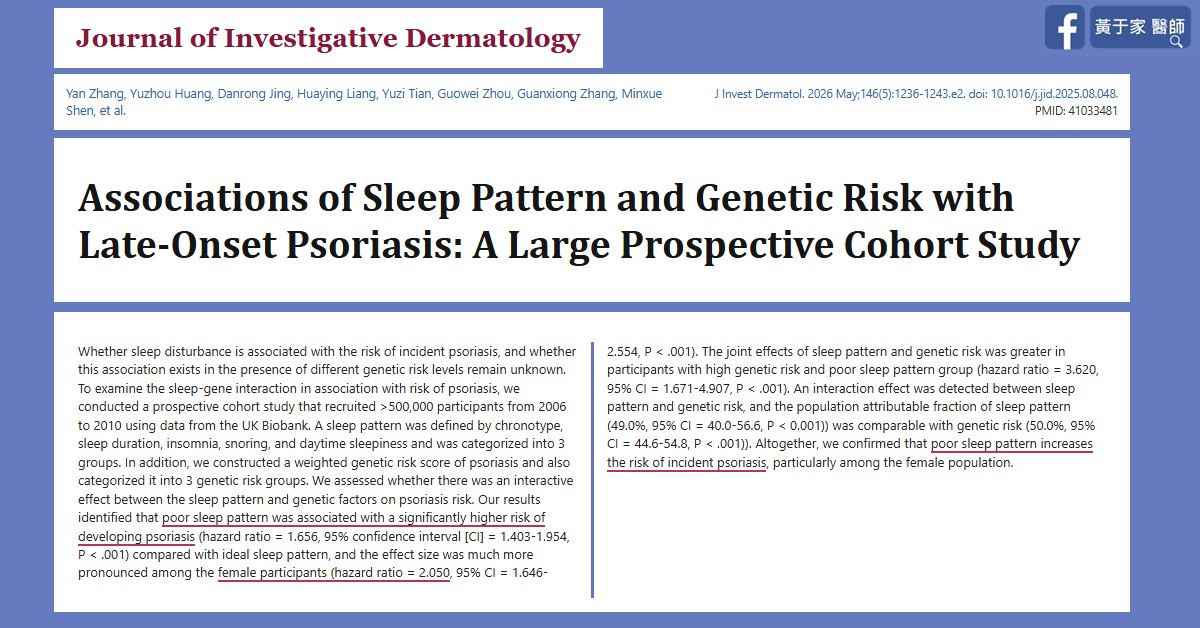
本篇研究,“Associations of Sleep Pattern and Genetic Risk with Late-Onset Psoriasis: A Large Prospective Cohort Study”,期刊摘要如下:
Whether sleep disturbance is associated with the risk of incident psoriasis, and whether this association exists in the presence of different genetic risk levels remain unknown. To examine the sleep-gene interaction in association with risk of psoriasis, we conducted a prospective cohort study that recruited >500,000 participants from 2006 to 2010 using data from the UK Biobank. A sleep pattern was defined by chronotype, sleep duration, insomnia, snoring, and daytime sleepiness and was categorized into 3 groups. In addition, we constructed a weighted genetic risk score of psoriasis and also categorized it into 3 genetic risk groups. We assessed whether there was an interactive effect between the sleep pattern and genetic factors on psoriasis risk.
Our results identified that poor sleep pattern was associated with a significantly higher risk of developing psoriasis (hazard ratio = 1.656, 95% confidence interval [CI] = 1.403-1.954, P < .001) compared with ideal sleep pattern, and the effect size was much more pronounced among the female participants (hazard ratio = 2.050, 95% CI = 1.646-2.554, P < .001). The joint effects of sleep pattern and genetic risk was greater in participants with high genetic risk and poor sleep pattern group (hazard ratio = 3.620, 95% CI = 1.671-4.907, P < .001). An interaction effect was detected between sleep pattern and genetic risk, and the population attributable fraction of sleep pattern (49.0%, 95% CI = 40.0-56.6, P < 0.001)) was comparable with genetic risk (50.0%, 95% CI = 44.6-54.8, P < .001)).
Altogether, we confirmed that poor sleep pattern increases the risk of incident psoriasis, particularly among the female population.
原始論文
Zhang Y, Huang Y, Jing D, et al. Journal of Investigative Dermatology. 2026;146(5):1236-1243.e2. doi:10.1016/j.jid.2025.08.048
論文摘要(中文翻譯)
以下為中文翻譯,僅供參考,內容以英文原文為準。
睡眠型態與遺傳風險和晚發型乾癬的關聯:大型前瞻性世代研究
睡眠障礙是否與新發生乾癬的風險有關,以及在不同遺傳風險程度下這個關聯是否存在,目前仍不清楚。為了探討睡眠與基因的交互作用和乾癬風險的關聯,我們使用英國生物資料庫(UK Biobank)資料進行前瞻性世代研究,在 2006 至 2010 年間招募超過 50 萬名參與者。睡眠型態依時型(早睡早起或晚睡晚起)、睡眠時間、失眠、打鼾與白天嗜睡來定義,分成 3 組。另外建立乾癬的加權遺傳風險分數,也分成 3 個遺傳風險組。我們評估睡眠型態與遺傳因素對乾癬風險是否有交互作用。
結果顯示,與理想睡眠型態相比,睡眠型態差的人發生乾癬的風險明顯較高(風險比 1.656,95% 信賴區間 1.403–1.954,P < .001),且這個效應在女性參與者中更明顯(風險比 2.050,95% CI 1.646–2.554,P < .001)。同時具有高遺傳風險與睡眠型態差的人,兩者的合併效應更大(風險比 3.620,95% CI 1.671–4.907,P < .001)。睡眠型態與遺傳風險之間有交互作用;睡眠型態的族群可歸因分率(49.0%,95% CI 40.0–56.6,P < 0.001)與遺傳風險(50.0%,95% CI 44.6–54.8,P < .001)相當。
整體而言,我們證實睡眠型態差會增加新發生乾癬的風險,尤其是在女性族群。
相關治療紀錄
- 不再倚靠任何中西藥膏!雙殺乾癬與失眠困擾
- 惱人的臉部乾癬,純內服中醫經方 3 個月
- 乾癬數年,外用超強類固醇,中醫經方 7 周的治療歷程
- 乾癬患者自白:飲食和早睡做再好也只能讓乾癬不惡化
- 乾癬,中醫經方的治療實例