乾癬施打生物製劑,停用次數越多,復發就越快,治療效果也會越差 - 台灣六家醫學中心研究
很多乾癬患者打了生物製劑,皮膚改善後,最常問的就是:可以停了嗎?
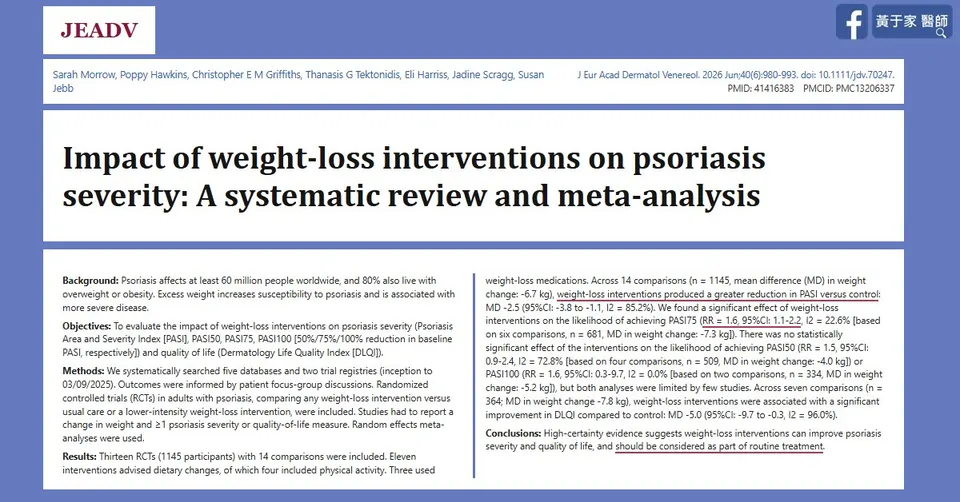
這篇台灣六家醫學中心皮膚科、長達 12 年的研究,分析 991 次「治療有效、在控制良好時停藥」的療程。
結果發現,過去停藥的次數越多,下次復發得越快,每多停一次,復發風險增加 23%。
而且停藥次數越多,治療期間能改善的程度越小。
不同藥物也有差別:停用 IL-23 抑制劑後復發得最慢,TNF-α 抑制劑最快。
作者也提醒,反覆停用生物製劑的利弊要審慎評估。
我在中醫師診間觀察:我看生物製劑、小分子藥物浪潮也引用過台灣乾癬協會的調查:約 500 多名乾癬病友中,有 53% 在停止生物製劑治療後三個月內快速復發。
生物製劑能有效控制乾癬,但「停藥之後怎麼辦」,是很多患者真正的困擾。
就像我在《不「藥」而癒》書評寫的:好的治療也必須在停止治療後,還是能維持不錯的生活品質。
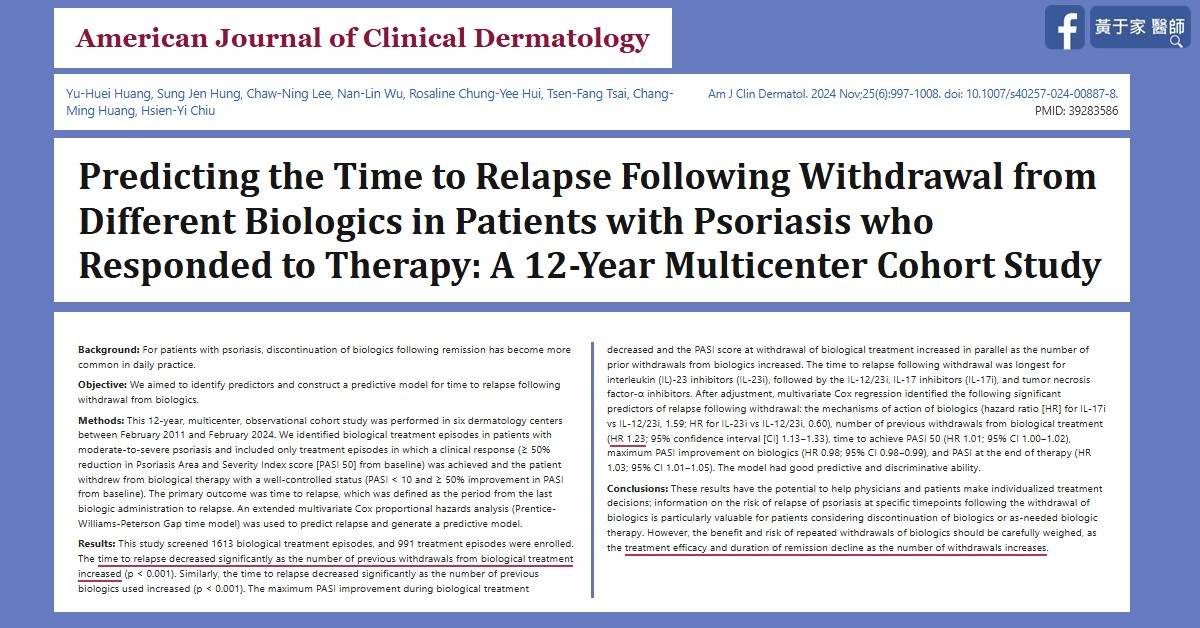
本篇研究,“Predicting the Time to Relapse Following Withdrawal from Different Biologics in Patients with Psoriasis who Responded to Therapy: A 12-Year Multicenter Cohort Study”,期刊摘要如下:
Background:
For patients with psoriasis, discontinuation of biologics following remission has become more common in daily practice.
Objective:
We aimed to identify predictors and construct a predictive model for time to relapse following withdrawal from biologics.
Methods:
This 12-year, multicenter, observational cohort study was performed in six dermatology centers between February 2011 and February 2024. We identified biological treatment episodes in patients with moderate-to-severe psoriasis and included only treatment episodes in which a clinical response (≥ 50% reduction in Psoriasis Area and Severity Index score [PASI 50] from baseline) was achieved and the patient withdrew from biological therapy with a well-controlled status (PASI < 10 and ≥ 50% improvement in PASI from baseline). The primary outcome was time to relapse, which was defined as the period from the last biologic administration to relapse. An extended multivariate Cox proportional hazards analysis (Prentice-Williams-Peterson Gap time model) was used to predict relapse and generate a predictive model.
Results:
This study screened 1613 biological treatment episodes, and 991 treatment episodes were enrolled. The time to relapse decreased significantly as the number of previous withdrawals from biological treatment increased (p < 0.001). Similarly, the time to relapse decreased significantly as the number of previous biologics used increased (p < 0.001). The maximum PASI improvement during biological treatment decreased and the PASI score at withdrawal of biological treatment increased in parallel as the number of prior withdrawals from biologics increased. The time to relapse following withdrawal was longest for interleukin (IL)-23 inhibitors (IL-23i), followed by the IL-12/23i, IL-17 inhibitors (IL-17i), and tumor necrosis factor-α inhibitors. After adjustment, multivariate Cox regression identified the following significant predictors of relapse following withdrawal: the mechanisms of action of biologics (hazard ratio [HR] for IL-17i vs IL-12/23i, 1.59; HR for IL-23i vs IL-12/23i, 0.60), number of previous withdrawals from biological treatment (HR 1.23; 95% confidence interval [CI] 1.13‒1.33), time to achieve PASI 50 (HR 1.01; 95% CI 1.00‒1.02), maximum PASI improvement on biologics (HR 0.98; 95% CI 0.98‒0.99), and PASI at the end of therapy (HR 1.03; 95% CI 1.01‒1.05). The model had good predictive and discriminative ability.
Conclusions:
These results have the potential to help physicians and patients make individualized treatment decisions; information on the risk of relapse of psoriasis at specific timepoints following the withdrawal of biologics is particularly valuable for patients considering discontinuation of biologics or as-needed biologic therapy. However, the benefit and risk of repeated withdrawals of biologics should be carefully weighed, as the treatment efficacy and duration of remission decline as the number of withdrawals increases.
原始論文
Huang YH, Hung SJ, Lee CN, et al. American Journal of Clinical Dermatology. 2024;25(6):997-1008. doi:10.1007/s40257-024-00887-8
論文摘要(中文翻譯)
以下為中文翻譯,僅供參考,內容以英文原文為準。
治療有反應的乾癬患者停用不同生物製劑後的復發時間預測:12 年多中心世代研究
背景:在日常臨床中,乾癬患者在病情緩解後停用生物製劑的情形越來越常見。
目的:找出停用生物製劑後復發時間的預測因子,並建立預測模型。
方法:這項為期 12 年的多中心觀察性世代研究,於 2011 年 2 月至 2024 年 2 月在 6 家皮膚科醫學中心進行。研究對象是中重度乾癬患者的生物製劑治療療程,只納入達到臨床反應(乾癬面積與嚴重度指數 PASI 較治療前改善 50% 以上,即 PASI 50),且在病情控制良好時(PASI 低於 10,且較治療前改善 50% 以上)停藥的療程。主要結果是復發時間,定義為最後一次施打生物製劑到復發的期間。以延伸的多變項 Cox 比例風險分析(Prentice-Williams-Peterson 間隔時間模型)預測復發並建立預測模型。
結果:共篩選 1613 個生物製劑療程,納入 991 個。過去停用生物製劑的次數越多,復發時間明顯越短(p < 0.001);過去用過的生物製劑種類越多,復發時間同樣明顯越短(p < 0.001)。隨著先前停藥次數增加,治療期間 PASI 的最大改善幅度隨之下降,停藥時的 PASI 分數則隨之上升。依藥物類別來看,停藥後到復發的時間以 IL-23 抑制劑最長,其次是 IL-12/23 抑制劑、IL-17 抑制劑,最短的是 TNF-α 抑制劑。校正後的多變項 Cox 迴歸找出以下停藥後復發的顯著預測因子:生物製劑的作用機轉(IL-17 抑制劑對 IL-12/23 抑制劑的風險比 1.59;IL-23 抑制劑對 IL-12/23 抑制劑 0.60)、過去停用生物製劑的次數(風險比 1.23;95% 信賴區間 1.13–1.33)、達到 PASI 50 所需時間(風險比 1.01;95% CI 1.00–1.02)、治療期間 PASI 的最大改善幅度(風險比 0.98;95% CI 0.98–0.99),以及停藥時的 PASI(風險比 1.03;95% CI 1.01–1.05)。這個模型有良好的預測與區辨能力。
結論:這些結果可以幫助醫師與患者做出個人化的治療決定;對於考慮停用生物製劑或需要時才施打的患者,停藥後特定時間點的復發風險資訊特別有參考價值。不過,反覆停用生物製劑的利弊應審慎評估,因為隨著停藥次數增加,治療效果與緩解期都會下降。
相關治療紀錄
- 乾癬多年,中醫經方治療前後的比對,停藥 2 年後乾癬依然穩定
- 乾癬多年,中醫經方治療 7 周後,以及停中藥半年後的皮膚比對
- 乾癬,多年,停中藥二個月後的現況追蹤
- 乾癬,中醫經方的治療實例
- 諸多患者停服中藥後的實況追蹤