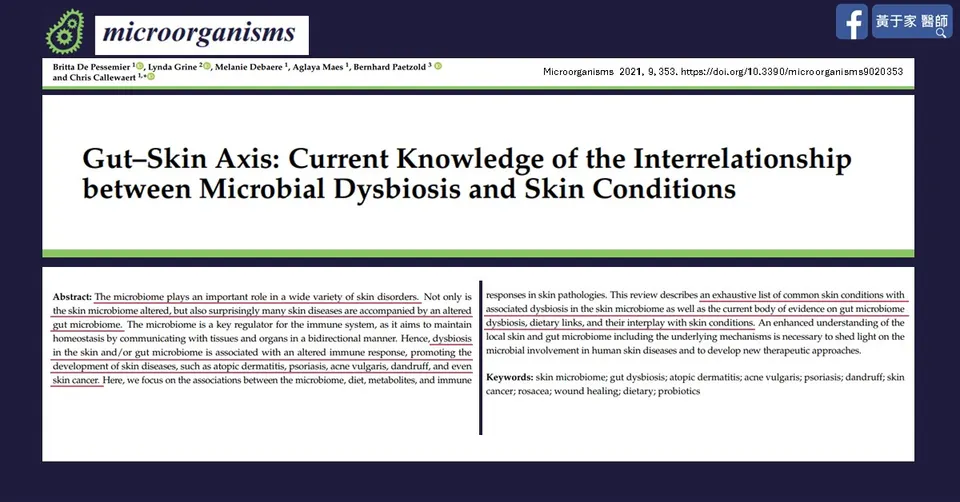
異位性皮膚炎、乾癬都與甜食有關,特別是添加糖的攝取
門診常有患者或家長問我:「是不是不能吃甜的?」「昨天喝了一杯手搖飲,晚上就癢起來,是巧合嗎?」
這個問題我在門診回答過很多次。這幾年陸續有研究在看甜食、加工食品和皮膚病的關係,這篇把我讀過的幾篇整理在一起,說明研究看到了什麼、還不能說什麼,以及日常生活可以怎麼做。
研究看到了什麼
韓國,學齡前兒童(2025)
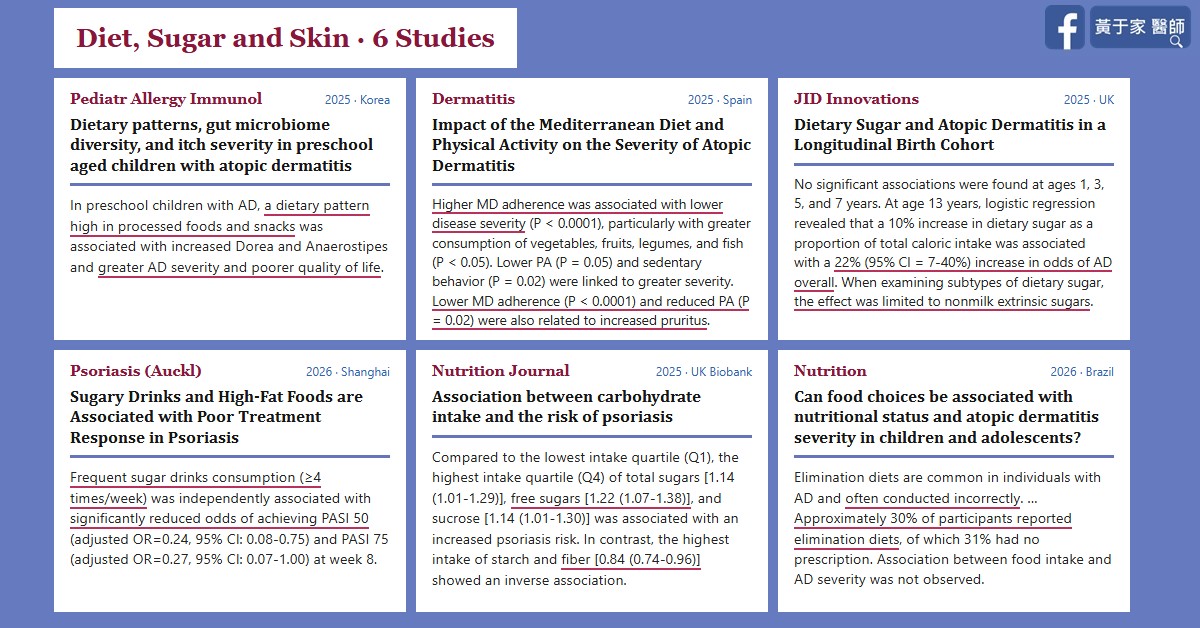
比較 3 到 6 歲的孩子,常吃加工食品和零食的異位性皮膚炎兒童,腸道菌相和其他孩子不同,晚上癢到影響睡眠的情形比較多,皮膚也比較嚴重,生活品質比較差。這些孩子的維生素 C 攝取也比較少。
西班牙,124 位中重度異位性皮膚炎患者(2025)
越少吃蔬菜、水果、豆類和魚的人,皮膚越嚴重、越癢;活動量越少、坐得越久,也越嚴重。
英國,5,372 位兒童從出生追蹤到 13 歲(2025)
1 到 10 歲時看不出關聯,但到了 13 歲左右的青春期,飲食中的糖佔總熱量的比例每多 10%,有異位性皮膚炎的機率多 22%;中重度的機率多 32%,越嚴重關聯越明顯。
上海,559 位乾癬患者(2026)
每週喝含糖飲料 4 次以上的人,治療 8 週後皮膚改善一半以上的機會,只有少喝的人的四分之一左右。
英國,UK Biobank 成人(2025)
添加糖吃得最多的人,之後得乾癬的風險高 22%;相反地,纖維吃得最多的人,風險低 16%。
重點不是「糖」,是「添加糖」
英國那篇研究把糖分成好幾種來看,結果發現,有關聯的只有添加糖(手搖飲、甜點等食物裡加進去的糖),牛奶本身的乳糖則沒有關聯。
所以要減少的,主要是這些:
- 手搖飲、汽水、運動飲料、市售果汁
- 蛋糕、餅乾、甜麵包、冰淇淋
- 糖果、巧克力、零食
天然食物裡的糖(例如原本的牛奶、整顆水果),不在這次研究看到的範圍內,不需要因此不敢吃。
要少到多少
不需要全部戒掉。
國民健康署建議,添加糖不要超過每天總熱量的 10%。世界衛生組織建議同樣是 10% 以下,如果能降到 5% 以下更好;以成人來說,5% 大約是 25 g 的糖。
現在連鎖手搖飲店都有標示糖量,點之前可以先看一下,一杯全糖飲料常常就會超過這個量。改成微糖、無糖,或從每天喝改成偶爾喝,就是很實際的第一步。
不建議自己大量忌口
少糖,不等於什麼都不能吃。
巴西一篇 2026 年的研究發現,約三成的異位性皮膚炎兒童和青少年有在忌口,其中有一部分並沒有經過醫療人員建議。那篇研究也沒有看到「吃什麼」和皮膚嚴重度之間有明顯關聯。
孩子還在發育,忌口太多反而可能營養不夠。如果懷疑某種食物讓皮膚變差,建議先記錄、和醫師討論,不要一下子把很多食物都拿掉。
來我門診的患者會發現,我從不給病人嚴格的飲食禁忌,詳見就是不想靠外擦,內服中藥幫你從根本解決問題。
我在抽血檢查能預知食物過敏、中藥過敏嗎?一文也提過,比起抽血檢查,更可行的是仔細記錄日常飲食內容。
家有異位性皮膚炎孩童,也常因為飲食的限制,親子吵得不可開交。生活起居上若有難以管教的情況,可以適當交由醫師跟孩子溝通,詳見當家裡沒有快樂起來的理由與異位性皮膚炎病童家長該如何有效陪同就診?。
研究還不能說什麼
這幾篇都是觀察性研究,只能說「吃得多的人,比較常有、比較嚴重、比較癢」,還不能證明是糖直接造成的。常吃甜食的人,可能同時也睡得比較晚、活動比較少、蔬果吃得比較少,這些都可能有影響。
而且每個人狀況不同,有人吃甜食後明顯變癢,也有人看不出差別。
吃太鹹也一樣,英國研究發現,鈉攝取越多,異位性皮膚炎越常見、發作越頻繁,詳見過多鹽分攝取會增加異位性皮膚炎的發生嗎?英國研究:鈉攝取過多會導致膚況惡化及異位性皮膚炎更頻繁發作。
我想說的
研究只能說到「有關」,但我在臨床上的觀察是,甜食的確會讓皮膚病灶惡化,2019 年我在丹羽療法就真的萬無一失?就寫過;談手部濕疹的戒掉毒蘋果,也把減少甜食、垃圾食物列為生活調整的一環。
飲食調整是輔助,不是治療的全部。皮膚的治療還是要持續,飲食和作息是在旁邊幫忙,讓治療的效果比較穩定。
如果你發現自己或孩子吃了甜食之後比較癢,不妨先試著減少手搖飲和甜點兩三週,同時觀察皮膚和睡眠的變化,回診時跟我說。
原始論文與摘要
以下依文中順序,附上六篇研究的原始論文、英文摘要與中文翻譯。中文翻譯僅供參考,內容以英文原文為準。
韓國,學齡前兒童(2025)
Park J, Lee SJ, Yan J, Kim S, Kim J, Lim C, Kim H, Jung M. Pediatric Allergy and Immunology. 2025;36(9):e70202. doi:10.1111/pai.70202
Background: The diet-gut microbiota-disease axis has been explored in infancy, but its role in preschool atopic dermatitis (AD) remains unclear. This study investigated associations between dietary patterns, gut microbiota, and AD severity in Korean preschoolers.
Methods: We evaluated 75 preschool children aged 3-6 years, including 24 with AD and 51 healthy controls. AD severity was assessed by Eczema Area and Severity Index (EASI) and SCORing Atopic Dermatitis (SCORAD), and quality of life by Children’s Dermatology Life Quality Index (CDLQI). Gut microbiota composition was characterized using 16S rRNA sequencing, and group differences were analyzed by Linear Discriminant Analysis Effect Size (LEfSe).
Results: Based on factor analysis, dietary patterns were categorized into a Traditional Korean (TK) diet and a Processed food and Snack (PS) diet. Children with AD who followed the PS diet showed lower vitamin C intake and higher levels of Dorea and Anaerostipes (LDA scores: 3.4 and 3.9). This microbial composition was associated with greater sleep-disturbing itching and poorer CDLQI (p = .032 and .041). Lower vitamin C intake correlated with higher Anaerostipes abundance (r = -.436, p = .042) as well as with higher EASI (r = -.52, p = .03) and SCORAD (r = -.41, p = .045). Dorea abundance was positively correlated with daytime itching (r = .42, p = .049).
Conclusions: In preschool children with AD, a dietary pattern high in processed foods and snacks was associated with increased Dorea and Anaerostipes and greater AD severity and poorer quality of life. These findings suggest that dietary modification may alleviate clinical symptoms in early childhood AD by modulating the diet-gut-skin axis.
中文翻譯
背景:「飲食—腸道菌—疾病」之間的關聯,過去多在嬰兒期研究,學齡前異位性皮膚炎的情形仍不清楚。本研究探討韓國學齡前兒童的飲食型態、腸道菌與異位性皮膚炎嚴重度的關係。
方法:納入 75 位 3 到 6 歲的學齡前兒童,其中 24 位有異位性皮膚炎、51 位為健康對照。以濕疹面積與嚴重度指數(EASI)及異位性皮膚炎評分(SCORAD)評估嚴重度,以兒童皮膚科生活品質指數(CDLQI)評估生活品質;以 16S rRNA 定序分析腸道菌組成,並以 LEfSe 分析比較組間差異。
結果:依因素分析,飲食型態分為「韓國傳統飲食」與「加工食品與零食飲食」兩類。吃「加工食品與零食」型態的異位性皮膚炎兒童,維生素 C 攝取較少,腸道中的 Dorea 菌與 Anaerostipes 菌較多(LDA 分數 3.4 與 3.9);這樣的菌相與癢到影響睡眠較多、生活品質較差有關(p = .032 與 .041)。維生素 C 攝取越少,Anaerostipes 菌越多(r = -.436,p = .042),EASI(r = -.52,p = .03)與 SCORAD(r = -.41,p = .045)也越高。Dorea 菌越多,白天越癢(r = .42,p = .049)。
結論:學齡前異位性皮膚炎兒童,常吃加工食品和零食的飲食型態,與 Dorea、Anaerostipes 菌增加、異位性皮膚炎較嚴重、生活品質較差有關。研究者認為,調整飲食或許能透過「飲食—腸道—皮膚」這條路徑,減輕幼兒異位性皮膚炎的症狀。
西班牙,124 位中重度異位性皮膚炎患者(2025)
Impact of the Mediterranean Diet and Physical Activity on the Severity of Atopic Dermatitis(外部網站)
Sanabria-de la Torre R, Ureña-Paniego C, Arias-Santiago S, Montero-Vílchez T. Dermatitis. 2025 Sep 10. doi:10.1177/17103568251376645
Background: Atopic dermatitis (AD) is a common chronic inflammatory skin condition influenced by genetic and environmental factors. The role of lifestyle on AD remains unclear. This study explores the association between adherence to the Mediterranean diet (MD), physical activity (PA) levels, and AD severity.
Methods: A cross-sectional study was conducted on AD patients. Disease severity was assessed using the Eczema Area and Severity Index (EASI) and the Patient Oriented Eczema Measure (POEM) scores, among others. MD adherence was evaluated using the Prevention with Mediterranean Diet (PREDIMED) questionnaire, and PA levels via the International Physical Activity Questionnaire (IPAQ).
Results: 124 AD patients with moderate-to-severe disease (EASI 11.44 ± 11.64, POEM 12.46 ± 23.12) were included. MD adherence was moderate (7.55 ± 1.93), as were PA levels (2,265.34 ± 3,098.45 METs). Higher MD adherence was associated with lower disease severity (P < 0.0001), particularly with greater consumption of vegetables, fruits, legumes, and fish (P < 0.05). Lower PA (P = 0.05) and sedentary behavior (P = 0.02) were linked to greater severity. Lower MD adherence (P < 0.0001) and reduced PA (P = 0.02) were also related to increased pruritus.
Conclusion: AD patients showed low adherence to both the MD and PA. The MD could be an appropriate dietary pattern for AD, and combining this with increased PA could offer additional benefits.
中文翻譯
背景:異位性皮膚炎是常見的慢性發炎性皮膚病,受基因與環境因素影響,生活型態扮演的角色仍不清楚。本研究探討遵循地中海飲食的程度、身體活動量,與異位性皮膚炎嚴重度的關係。
方法:以異位性皮膚炎患者進行橫斷性研究。以濕疹面積與嚴重度指數(EASI)、患者自評濕疹量表(POEM)等評估嚴重度;以 PREDIMED 問卷評估地中海飲食遵循程度,以國際身體活動量表(IPAQ)評估活動量。
結果:共納入 124 位中重度異位性皮膚炎患者(EASI 11.44 ± 11.64,POEM 12.46 ± 23.12)。地中海飲食遵循程度中等(7.55 ± 1.93),活動量也屬中等(2,265.34 ± 3,098.45 METs)。越遵循地中海飲食,病情越輕(P < 0.0001),尤其是蔬菜、水果、豆類和魚吃得越多(P < 0.05)。活動量較少(P = 0.05)與久坐(P = 0.02)都與病情較嚴重有關。較少遵循地中海飲食(P < 0.0001)與活動量較少(P = 0.02),也與較癢有關。
結論:異位性皮膚炎患者遵循地中海飲食與身體活動的程度都偏低。地中海飲食可能是適合異位性皮膚炎的飲食方式,若再增加活動量,可能有額外的好處。
英國,5,372 位兒童從出生追蹤到 13 歲(2025)
Dietary Sugar and Atopic Dermatitis in a Longitudinal Birth Cohort(外部網站)
Shan J, Ye M, Wang SP, Kang H, Lee A, Langan SM, Van Blarigan EL, Abuabara K. JID Innovations. 2025;5(3):100366. doi:10.1016/j.xjidi.2025.100366
Importance: The association of diet with atopic dermatitis (AD) in children is understudied and may present an opportunity to optimize AD management in a cost-effective and low-risk manner.
Objective: The aim of this study was to determine the extent to which dietary sugar is associated with AD period prevalence and severity in a longitudinal pediatric cohort.
Design, Setting, and Participants: This was a longitudinal cohort study of children from the Avon Longitudinal Study of Parents and Children with food frequency questionnaire data to estimate dietary carbohydrate and sugar at 1, 3, 5, 7, 10, and 13 years.
Exposure: The exposure was dietary sugar as a proportion of total caloric intake.
Main Outcome and Measure: The primary outcome was AD based on a maternal- or self-reported questionnaire that asked about disease activity and severity over the past 12 months. Logistic regression models adjusted for sex, race, maternal delivery age, highest parental education level, social class assessed through parental occupation, body mass index, total caloric intake, and maternal history of AD.
Results: The study population included 5372 unique participants, 50% of whom were female, and 20-30% of whom reported AD at any time point. No significant associations were found at ages 1, 3, 5, and 7 years. At age 13 years, logistic regression revealed that a 10% increase in dietary sugar as a proportion of total caloric intake was associated with a 22% (95% confidence interval = 7-40%) increase in odds of AD overall. There was a dose-response relationship with disease severity: there was a 19% (95% confidence interval = 0-42%) increase in the odds of mild AD and 32% (95% confidence interval = 5-86%) increase in the odds of moderate-severe AD. When examining subtypes of dietary sugar, the effect was limited to nonmilk extrinsic sugars.
Conclusions and Relevance: Given the known health benefits, reduction of nonmilk sugars could be studied as a cost-effective and low-risk intervention for AD in late childhood and early adolescence.
本篇摘要依 CC BY-NC-ND 4.0 授權轉載,著作權屬原作者。
中文翻譯
重要性:兒童飲食與異位性皮膚炎的關係研究不多,若能釐清,可能成為成本低、風險小的異位性皮膚炎照護方式。
目的:在長期追蹤的兒童世代中,探討飲食中的糖與異位性皮膚炎盛行率及嚴重度的關聯程度。
研究設計、場域與對象:本研究為長期世代研究,對象是英國「雅芳親子縱貫研究」(ALSPAC)的兒童,以食物頻率問卷估算他們在 1、3、5、7、10、13 歲時飲食中的碳水化合物與糖攝取量。
暴露因子:飲食中的糖佔總熱量的比例。
主要結果與測量方式:主要結果為異位性皮膚炎,依母親填寫或本人自填的問卷判定,問卷詢問過去 12 個月的病情活動度與嚴重度。邏輯斯迴歸模型校正了性別、種族、母親生產年齡、父母最高教育程度、以父母職業評估的社會階層、身體質量指數(BMI)、總熱量攝取,以及母親是否有異位性皮膚炎病史。
結果:共納入 5372 位參與者,其中 50% 為女性,各時間點有 20–30% 的人回報有異位性皮膚炎。1、3、5、7 歲時,糖攝取與異位性皮膚炎沒有明顯關聯。到了 13 歲,糖佔總熱量的比例每增加 10%,有異位性皮膚炎的機率增加 22%(95% 信賴區間 7–40%)。這個關聯與病情嚴重度呈劑量反應關係:輕度異位性皮膚炎的機率增加 19%(95% 信賴區間 0–42%),中重度增加 32%(95% 信賴區間 5–86%)。進一步區分糖的種類後發現,關聯只出現在「非乳源的外加糖」(nonmilk extrinsic sugars,即牛奶本身乳糖以外、額外添加或來自果汁等的糖)。
結論與意義:減少非乳源的糖本身已知有益健康,可以進一步研究,作為青春期前後兒童異位性皮膚炎低成本、低風險的介入方式。
上海,559 位乾癬患者(2026)
Song J, Luo Y, Zhang R, Gao X, Shen F, Cai R, Lu J, Xu H, Ma X, Li B, Jiang W, Wang R. Psoriasis (Auckland). 2026;16:617180. doi:10.2147/PTT.S617180
Purpose: While dietary factors are known to be associated with the development and progression of psoriasis, their effect on treatment efficacy remains unclear. Therefore, this study aimed to elucidate the influence of tea consumption, sugar drinks, and high-fat foods on the treatment response in psoriasis.
Patients and Methods: We undertook a prospective cohort study comprising 559 patients with psoriasis from Shanghai Skin Disease Hospital between 2022 and 2024. Data on demographics, lifestyle (including tea, sugary drinks, and high-fat food consumption), and disease severity (PASI, BSA, PGA) were collected via structured questionnaires at baseline, week 4, and week 8. The primary endpoints were the proportions of patients achieving PASI 50 responses at week 8. Multivariable logistic regression was used to estimate odds ratios with 95% confidence intervals, adjusting for age, sex, BMI, smoking, alcohol, and treatment regimen. Data were analyzed using SAS 9.4 software.
Results: In the psoriasis cohort (mean age 48.5 years; 73.2% male), 37.1% and 68.7% of patients consumed sugar drinks and high-fat foods ≥2 times/week, respectively. Frequent sugar drinks consumption (≥4 times/week) was independently associated with significantly reduced odds of achieving PASI 50 (adjusted OR=0.24, 95% CI: 0.08-0.75) and PASI 75 (adjusted OR=0.27, 95% CI: 0.07-1.00) at week 8. Moderate intake of high-fat foods (2-3 times/week) showed an inverse, borderline significant association with PASI 50 at week 4 (adjusted OR=0.68, 95% CI: 0.45-1.00). Tea consumption showed a non-significant association with treatment response (e.g, week 8 PASI 50 adjusted OR=1.44, 95% CI: 0.88-2.35), warranting further investigation in larger cohorts.
Conclusion: This study demonstrates that high consumption of sugar drinks and high-fat foods is associated with suboptimal treatment response in psoriasis. Tea consumption was not significantly associated with treatment outcomes, although further investigation with larger cohorts may be warranted. These findings highlight the importance of integrating dietary assessment and counseling into comprehensive psoriasis management.
本篇摘要依 CC BY-NC 3.0 授權轉載,著作權屬原作者。
中文翻譯
目的:已知飲食因素與乾癬的發生和惡化有關,但對治療效果的影響仍不清楚。本研究探討喝茶、含糖飲料與高脂食物對乾癬治療反應的影響。
患者與方法:前瞻性世代研究,納入 2022 至 2024 年上海市皮膚病醫院 559 位乾癬患者。在治療開始、第 4 週與第 8 週,以結構式問卷收集基本資料、生活型態(包括喝茶、含糖飲料與高脂食物的頻率)與嚴重度(PASI、BSA、PGA)。主要評估指標為第 8 週達到 PASI 50(嚴重度改善一半以上)的比例。以多變項邏輯斯迴歸估算勝算比與 95% 信賴區間,並校正年齡、性別、BMI、抽菸、喝酒與治療方式,資料以 SAS 9.4 分析。
結果:患者平均 48.5 歲,73.2% 為男性;每週喝含糖飲料 2 次以上的有 37.1%,每週吃高脂食物 2 次以上的有 68.7%。常喝含糖飲料(每週 4 次以上)的人,第 8 週達到 PASI 50 的機會明顯較低(校正後勝算比 0.24,95% 信賴區間 0.08–0.75),達到 PASI 75 的機會也較低(校正後勝算比 0.27,95% 信賴區間 0.07–1.00)。每週吃 2–3 次高脂食物的人,第 4 週達到 PASI 50 的機會較低,接近統計顯著(校正後勝算比 0.68,95% 信賴區間 0.45–1.00)。喝茶與治療反應沒有顯著關聯(例如第 8 週 PASI 50 校正後勝算比 1.44,95% 信賴區間 0.88–2.35),需要更大型的研究再確認。
結論:常喝含糖飲料、常吃高脂食物,與乾癬治療效果較差有關。喝茶與治療結果沒有顯著關聯,但仍可能需要更大型的研究確認。研究者認為,乾癬的整體治療應納入飲食評估與飲食建議。
英國,UK Biobank 成人(2025)
Lin H, Yang Y, He C, Wang M, Ye D, Sun X, Guo J, Li J, Mao Y. Nutrition Journal. 2025;24(1):142. doi:10.1186/s12937-025-01210-9
Background: Research on the association between carbohydrate intake and psoriasis risk is limited. We aimed to examine the associations of carbohydrate and its different subtypes with psoriasis risk, as well as the interaction between genetic predisposition and carbohydrate intake.
Methods: We performed a prospective cohort study based on UK Biobank that included 210,474 participants who did not have psoriasis at baseline. A 24-hour dietary assessment tool was used to assess detailed dietary intake information. Incident psoriasis events were identified through hospitalization records. The association between carbohydrate intake and psoriasis was examined by Cox proportional hazard regression models. Multiplicative interaction between genetic risk and carbohydrate intake was assessed by incorporating a cross-product term in the model.
Results: A total of 1907 incident psoriasis events were recorded during the follow-up period (median: 13.25 years). Compared to the lowest intake quartile (Q1), the highest intake quartile (Q4) of total sugars [HR (95% CI) = 1.14 (1.01-1.29), FDR-Ptrend = 0.116], free sugars [1.22 (1.07-1.38), 0.021], and sucrose [1.14 (1.01-1.30), 0.058] was associated with an increased psoriasis risk. In contrast, the highest intake of starch [0.86 (0.76-0.98), 0.049] and fiber [0.84 (0.74-0.96), 0.021] showed an inverse association with psoriasis risk. However, there was no statistically significant interaction between carbohydrate intake and genetic risk.
Conclusion: Intake of total sugars, free sugar, and sucrose was positively associated with psoriasis risk, while fiber and starch were inversely associated.
本篇摘要依 CC BY-NC-ND 4.0 授權轉載,著作權屬原作者。
中文翻譯
背景:碳水化合物攝取與乾癬風險之間的研究有限。本研究探討碳水化合物及其各種類與乾癬風險的關係,以及遺傳傾向與碳水化合物攝取之間是否有交互作用。
方法:以英國生物資料庫(UK Biobank)進行前瞻性世代研究,納入 210,474 位起始時沒有乾癬的參與者,以 24 小時飲食評估工具記錄詳細飲食內容,新發生的乾癬以住院紀錄判定。以 Cox 比例風險迴歸模型分析碳水化合物攝取與乾癬的關係,並在模型中加入交乘項,評估遺傳風險與碳水化合物攝取的交互作用。
結果:追蹤期間(中位數 13.25 年)共有 1907 人新發生乾癬。與攝取量最低的四分之一(Q1)相比,攝取量最高的四分之一(Q4):總糖量〔風險比 1.14(95% 信賴區間 1.01–1.29),FDR 校正趨勢 P 值 0.116〕、游離糖〔1.22(1.07–1.38),0.021〕、蔗糖〔1.14(1.01–1.30),0.058〕都與乾癬風險較高有關。相反地,澱粉〔0.86(0.76–0.98),0.049〕與纖維〔0.84(0.74–0.96),0.021〕攝取最多的人,乾癬風險較低。碳水化合物攝取與遺傳風險之間沒有統計上顯著的交互作用。
結論:總糖量、游離糖與蔗糖的攝取與乾癬風險呈正相關,纖維與澱粉則呈負相關。
巴西,104 位兒童與青少年(2026)
Bachelli TCP, Secamilli EN, Maciel MG, França AFEDC, Cazarin CBB. Nutrition. 2026;143:113023. doi:10.1016/j.nut.2025.113023
Atopic dermatitis (AD) is a chronic and relapsing skin disease frequently observed in childhood with a multifactorial pathogenesis; however, diet is a contributing factor. Some studies have verified that fruit, vegetables, milk, or meat intake (>1x/wk) reduced the incidence of AD symptoms. Otherwise, highly frequent fast-food consumption (>1x/wk) is associated with increased AD symptoms. Also, elimination diets are common in individuals with AD and often conducted incorrectly. The present study hypothesizes that food intake can be associated with AD severity and nutritional status. A food frequency questionnaire was administered to assess food frequency and elimination diets, in addition to obtaining anthropometric data to estimate nutritional status. One hundred and four individuals participated in the study, with age ranging from 1 to 17 y and 11 mo. The results indicated no significant association between food intake and nutritional status or SCORAD (P > 0.05). Approximately 30% of participants reported elimination diets, of which 31% had no prescription. Elimination diet was adopted by 29.8% of participants, with most (67.7%) stating that they were restricting certain foods on the recommendation of a health care provider. Association between food intake and AD severity was not observed. However, the consumption of some ultra-processed foods was associated with nutritional status. We encourage qualitative research on food consumption and cause-effect research on the association between elimination diets and worsened AD symptoms. This study was registered at the Brazilian Registry of Clinical Trials-ReBEC (RBR-7q6g5b).
中文翻譯
異位性皮膚炎是兒童常見、反覆發作的慢性皮膚病,成因多重,飲食是其中一項因素。有些研究發現,每週吃水果、蔬菜、牛奶或肉類一次以上,異位性皮膚炎症狀較少;相反地,每週吃速食一次以上,症狀較多。此外,異位性皮膚炎患者常有忌口,而且忌口的方式常常不正確。本研究假設飲食內容可能與異位性皮膚炎嚴重度及營養狀態有關,以食物頻率問卷評估飲食頻率與忌口情形,並測量身高體重等數據評估營養狀態。共 104 人參與,年齡 1 歲到 17 歲 11 個月。結果顯示,飲食內容與營養狀態或 SCORAD 嚴重度都沒有顯著關聯(P > 0.05)。約 30% 的參與者有忌口,其中 31% 沒有經過醫療人員指示;有忌口的 29.8% 參與者中,多數(67.7%)表示是依醫療人員建議限制某些食物。飲食內容與異位性皮膚炎嚴重度之間沒有看到關聯,但某些超加工食品的攝取與營養狀態有關。研究者建議,未來可針對飲食內容做質性研究,並研究忌口與異位性皮膚炎症狀惡化之間的因果關係。本研究已登錄於巴西臨床試驗登記平台(ReBEC,RBR-7q6g5b)。