異位性皮膚炎越頻繁發作生活品質越差,發作頻率與前一年疾病嚴重程度密切相關 - 丹麥研究
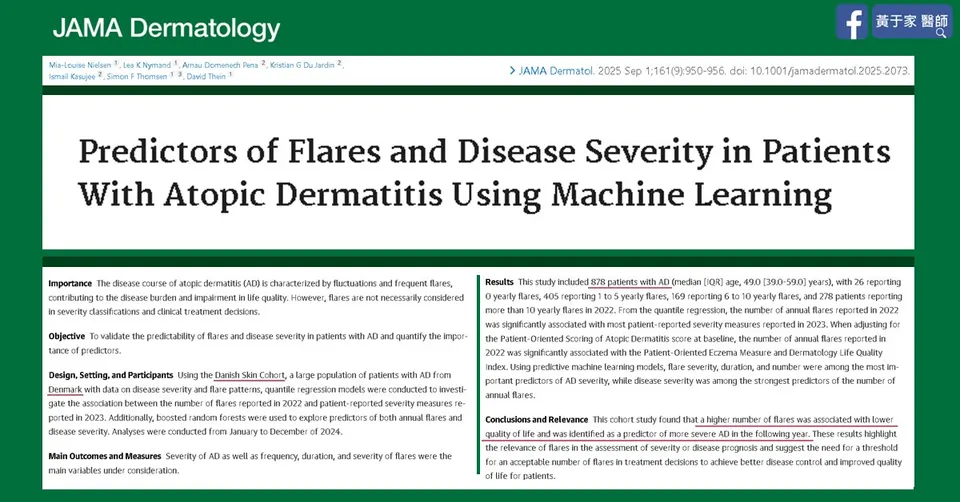
本篇研究,“Predictors of Flares and Disease Severity in Patients With Atopic Dermatitis Using Machine Learning”,請見這裡(外部網站),期刊摘要如下:
Importance:
The disease course of atopic dermatitis (AD) is characterized by fluctuations and frequent flares, contributing to the disease burden and impairment in life quality. However, flares are not necessarily considered in severity classifications and clinical treatment decisions.
Objective:
To validate the predictability of flares and disease severity in patients with AD and quantify the importance of predictors.
Design, setting, and participants:
Using the Danish Skin Cohort, a large population of patients with AD from Denmark with data on disease severity and flare patterns, quantile regression models were conducted to investigate the association between the number of flares reported in 2022 and patient-reported severity measures reported in 2023. Additionally, boosted random forests were used to explore predictors of both annual flares and disease severity. Analyses were conducted from January to December of 2024.
Main outcomes and measures:
Severity of AD as well as frequency, duration, and severity of flares were the main variables under consideration.
Results:
This study included 878 patients with AD (median [IQR] age, 49.0 [39.0-59.0] years), with 26 reporting 0 yearly flares, 405 reporting 1 to 5 yearly flares, 169 reporting 6 to 10 yearly flares, and 278 patients reporting more than 10 yearly flares in 2022. From the quantile regression, the number of annual flares reported in 2022 was significantly associated with most patient-reported severity measures reported in 2023. When adjusting for the Patient-Oriented Scoring of Atopic Dermatitis score at baseline, the number of annual flares reported in 2022 was significantly associated with the Patient-Oriented Eczema Measure and Dermatology Life Quality Index. Using predictive machine learning models, flare severity, duration, and number were among the most important predictors of AD severity, while disease severity was among the strongest predictors of the number of annual flares.
Conclusions and relevance:
This cohort study found that a higher number of flares was associated with lower quality of life and was identified as a predictor of more severe AD in the following year. These results highlight the relevance of flares in the assessment of severity or disease prognosis and suggest the need for a threshold for an acceptable number of flares in treatment decisions to achieve better disease control and improved quality of life for patients.
原始論文
Nielsen ML, Nymand LK, Pena AD, Du Jardin KG, et al. JAMA Dermatology. 2025;161(9):950-956. doi:10.1001/jamadermatol.2025.2073
論文摘要(Google 翻譯)
以下為 Google 翻譯,並校正明顯錯誤,僅供參考,內容以英文原文為準。
以機器學習預測異位性皮膚炎患者的發作與疾病嚴重度
重要性:異位性皮膚炎(AD)的病程特徵為起伏波動與頻繁發作,加重疾病負擔並損害生活品質。然而,嚴重度分類與臨床治療決策未必會將發作納入考量。
目的:驗證 AD 患者發作與疾病嚴重度的可預測性,並量化各預測因子的重要性。
設計、場域與參與者:使用丹麥皮膚世代(Danish Skin Cohort)——一個具有疾病嚴重度與發作模式資料的大型丹麥 AD 患者族群——以分位數迴歸模型探討 2022 年所報告的發作次數,與 2023 年患者自評嚴重度指標之間的關聯。此外,以提升式隨機森林探索年度發作次數與疾病嚴重度的預測因子。分析於 2024 年 1 月至 12 月進行。
主要結果與測量指標:主要考量的變項為 AD 嚴重度,以及發作的頻率、持續時間與嚴重度。
結果:本研究納入 878 名 AD 患者(年齡中位數[IQR]49.0[39.0–59.0]歲),2022 年中有 26 名報告每年 0 次發作,405 名報告每年 1 至 5 次,169 名報告每年 6 至 10 次,278 名報告每年超過 10 次。分位數迴歸顯示,2022 年報告的年度發作次數,與 2023 年多數患者自評嚴重度指標顯著相關。在校正基線的「患者導向異位性皮膚炎評分」後,2022 年報告的年度發作次數與「患者導向濕疹評估量表」及「皮膚病生活品質指數」顯著相關。在預測性機器學習模型中,發作的嚴重度、持續時間與次數是 AD 嚴重度最重要的預測因子之一,而疾病嚴重度則是年度發作次數最強的預測因子之一。
結論與意義:本世代研究發現,發作次數越多與生活品質越差相關,且是隔年 AD 較嚴重的預測因子。這些結果凸顯發作在評估嚴重度或疾病預後上的重要性,並顯示治療決策中需要訂定可接受發作次數的門檻,以達到更好的疾病控制並改善患者生活品質。
異位性皮膚炎,期刊研究,請看這裡。
期刊研究整理,請見這裡。
接下來讀這幾篇
原文發表於 作者部落格(舊部落格)。