異位性皮膚炎,注射杜避炎,有可能另外衍生出乾癬
異位性皮膚炎,中醫經方的治療實例,請見這裡。
小兒異位性皮膚炎,中醫經方的治療實例,請見這裡。
成人異位性皮膚炎,中醫經方的治療實例,請見這裡。
異位性皮膚炎,期刊研究,請看這裡。
期刊研究整理,請見這裡。
更多杜避炎期刊,請見這裡。
本篇研究,Psoriasis Risk in Patients With Atopic Dermatitis Treated With Dupilumab,請見這裡(外部網站)。
Question:
Is dupilumab treatment associated with increased psoriasis risk in patients with atopic dermatitis?
Findings:
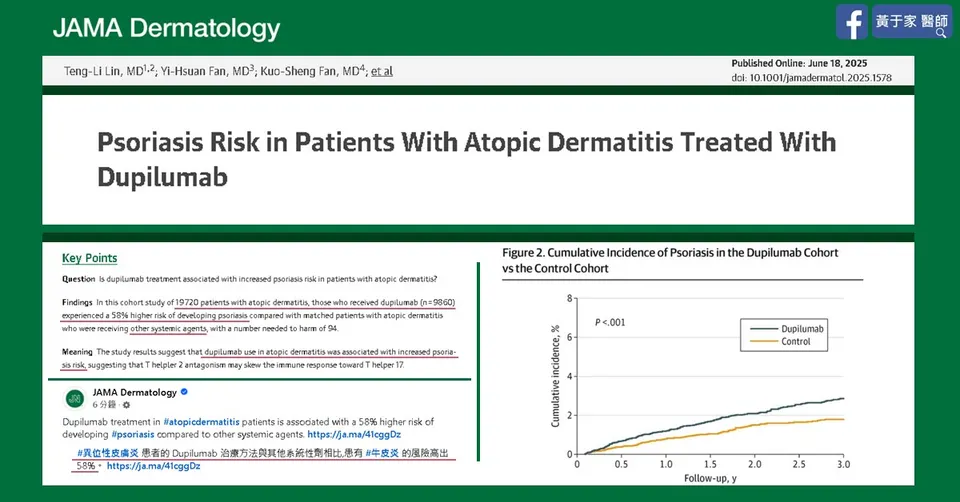
In this cohort study of 19720 patients with atopic dermatitis, those who received dupilumab (n = 9860) experienced a 58% higher risk of developing psoriasis compared with matched patients with atopic dermatitis who were receiving other systemic agents, with a number needed to harm of 94.
Meaning:
The study results suggest that dupilumab use in atopic dermatitis was associated with increased psoriasis risk, suggesting that T helpler 2 antagonism may skew the immune response toward T helper 17.
Importance:
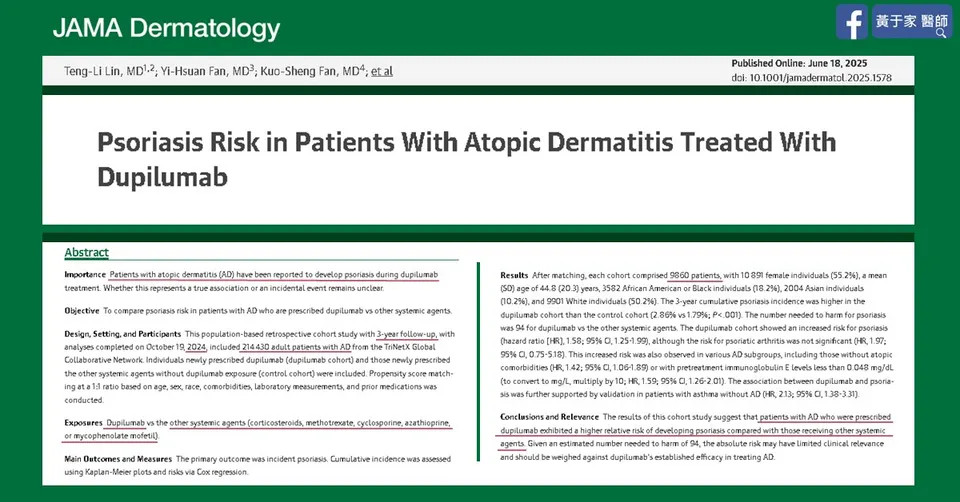
Patients with atopic dermatitis (AD) have been reported to develop psoriasis during dupilumab treatment. Whether this represents a true association or an incidental event remains unclear.
Objective:
To compare psoriasis risk in patients with AD who are prescribed dupilumab vs other systemic agents.
Design, Setting, and Participants:
This population-based retrospective cohort study with 3-year follow-up, with analyses completed on October 19, 2024, included 214 430 adult patients with AD from the TriNetX Global Collaborative Network. Individuals newly prescribed dupilumab (dupilumab cohort) and those newly prescribed the other systemic agents without dupilumab exposure (control cohort) were included. Propensity score matching at a 1:1 ratio based on age, sex, race, comorbidities, laboratory measurements, and prior medications was conducted.
Exposures:
Dupilumab vs the other systemic agents (corticosteroids, methotrexate, cyclosporine, azathioprine, or mycophenolate mofetil).
Main Outcomes and Measures:
The primary outcome was incident psoriasis. Cumulative incidence was assessed using Kaplan-Meier plots and risks via Cox regression.
Results:
After matching, each cohort comprised 9860 patients, with 10 891 female individuals (55.2%), a mean (SD) age of 44.8 (20.3) years, 3582 African American or Black individuals (18.2%), 2004 Asian individuals (10.2%), and 9901 White individuals (50.2%). The 3-year cumulative psoriasis incidence was higher in the dupilumab cohort than the control cohort (2.86% vs 1.79%; P < .001). The number needed to harm for psoriasis was 94 for dupilumab vs the other systemic agents. The dupilumab cohort showed an increased risk for psoriasis (hazard ratio [HR], 1.58; 95% CI, 1.25-1.99), although the risk for psoriatic arthritis was not significant (HR, 1.97; 95% CI, 0.75-5.18). This increased risk was also observed in various AD subgroups, including those without atopic comorbidities (HR, 1.42; 95% CI, 1.06-1.89) or with pretreatment immunoglobulin E levels less than 0.048 mg/dL (to convert to mg/L, multiply by 10; HR, 1.59; 95% CI, 1.26-2.01). The association between dupilumab and psoriasis was further supported by validation in patients with asthma without AD (HR, 2.13; 95% CI, 1.38-3.31).
Conclusions and Relevance:
The results of this cohort study suggest that patients with AD who were prescribed dupilumab exhibited a higher relative risk of developing psoriasis compared with those receiving other systemic agents. Given an estimated number needed to harm of 94, the absolute risk may have limited clinical relevance and should be weighed against dupilumab’s established efficacy in treating AD.
原始論文
Psoriasis Risk in Patients With Atopic Dermatitis Treated With Dupilumab(外部網站)
Lin TL, Fan YH, Fan KS, Juan CK, et al. JAMA Dermatology. 2025;161(8):813-821. doi:10.1001/jamadermatol.2025.1578
論文摘要(Google 翻譯)
以下為 Google 翻譯,並校正明顯錯誤,僅供參考,內容以英文原文為準。
接受 dupilumab 治療的異位性皮膚炎患者之乾癬風險
問題:異位性皮膚炎患者接受 dupilumab 治療,是否與乾癬風險增加有關?
發現:在這項納入 19,720 名異位性皮膚炎患者的世代研究中,接受 dupilumab 的患者(n = 9860)與接受其他全身性藥物的配對異位性皮膚炎患者相比,發生乾癬的風險高 58%,需傷害人數(number needed to harm)為 94。
意義:研究結果顯示,異位性皮膚炎患者使用 dupilumab 與乾癬風險增加有關,意味著拮抗第 2 型輔助 T 細胞(Th2)可能使免疫反應偏向第 17 型輔助 T 細胞(Th17)。
重要性:已有報告指出異位性皮膚炎(AD)患者在 dupilumab 治療期間發生乾癬。這究竟是真正的關聯還是偶發事件,仍不清楚。
目的:比較使用 dupilumab 與使用其他全身性藥物的 AD 患者之乾癬風險。
設計、場域與參與者:這項以族群為基礎的回溯性世代研究追蹤 3 年,分析於 2024 年 10 月 19 日完成,納入 TriNetX 全球協作網絡中 214,430 名成年 AD 患者。納入新開立 dupilumab 者(dupilumab 世代),以及新開立其他全身性藥物且未曾使用 dupilumab 者(對照世代)。依年齡、性別、種族、共病、檢驗數值與先前用藥,以 1:1 比例進行傾向分數配對。
暴露因子:dupilumab 對比其他全身性藥物(類固醇、methotrexate、cyclosporine、azathioprine 或 mycophenolate mofetil)。
主要結果與測量指標:主要結果為新發生的乾癬。以 Kaplan-Meier 圖評估累積發生率,並以 Cox 迴歸評估風險。
結果:配對後,每個世代各有 9860 名患者,其中女性 10,891 名(55.2%),平均(SD)年齡 44.8(20.3)歲,非裔美國人或黑人 3582 名(18.2%),亞洲人 2004 名(10.2%),白人 9901 名(50.2%)。dupilumab 世代的 3 年累積乾癬發生率高於對照世代(2.86% 對 1.79%;P < .001)。dupilumab 相對於其他全身性藥物的乾癬需傷害人數為 94。dupilumab 世代的乾癬風險增加(風險比[HR]1.58;95% CI 1.25–1.99),但乾癬性關節炎的風險未達顯著(HR 1.97;95% CI 0.75–5.18)。此風險增加也見於多個 AD 次群組,包括無其他異位性共病者(HR 1.42;95% CI 1.06–1.89),或治療前免疫球蛋白 E 濃度低於 0.048 mg/dL 者(換算為 mg/L 須乘以 10;HR 1.59;95% CI 1.26–2.01)。在無 AD 的氣喘患者中進行驗證,也支持 dupilumab 與乾癬之間的關聯(HR 2.13;95% CI 1.38–3.31)。
結論與意義:本世代研究結果顯示,使用 dupilumab 的 AD 患者發生乾癬的相對風險高於使用其他全身性藥物者。由於估計需傷害人數為 94,絕對風險的臨床意義可能有限,應與 dupilumab 在治療 AD 上已確立的療效一併權衡。
接下來讀這幾篇
原文發表於 作者部落格(舊部落格)。