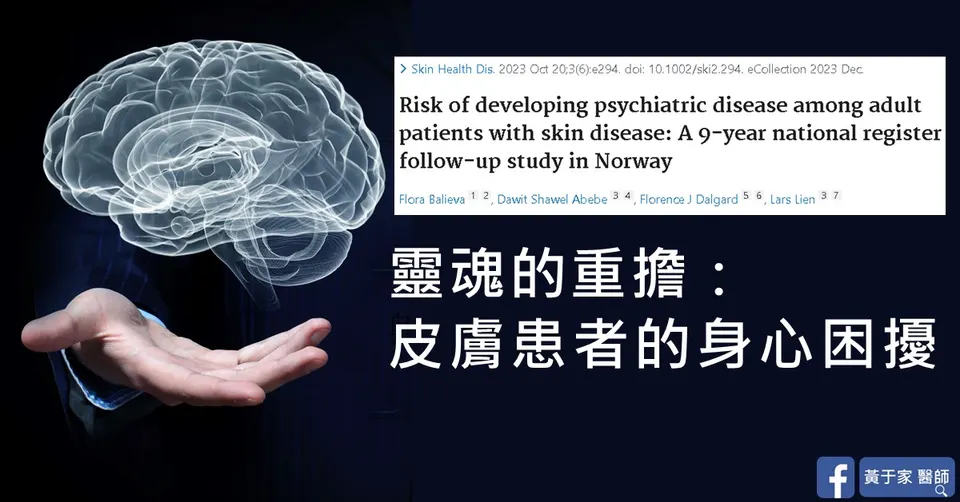
靈魂的重擔:皮膚患者有較高比例合併身心問題(憂鬱、焦慮、酗酒)- 挪威健保研究
此篇期刊摘要列於下:
Background
The existing association between skin disease and psychiatric comorbidity has gained attention during the last decades. Stress and mental illness can directly or indirectly affect skin disease, while dermatological conditions, known to impair life quality and mental well‐being, can promote psychiatric conditions.
Objectives
The aim of this study was to assess the risk of developing psychiatric disease among adult dermatological patients over a period of time. The secondary objective was to see which psychiatric disorders developed most commonly, and which skin diseases posed the greatest risk for later mental health issues.
Methods
Adult dermatological patients were followed for 9 years (2008–2016) using the Norwegian Patient Registry, for both outpatient and inpatient specialist healthcare services. Dermatological patients were identified during the first 2 years and were then followed for psychiatric comorbidity prospectively for the next 7 years.
Cox regression models were applied to estimate the risks of psychiatric disorders among patients with skin diseases. Estimates were adjusted for age and gender differences. Hazard risk ratios (HR) with 95% CI are reported.
Results
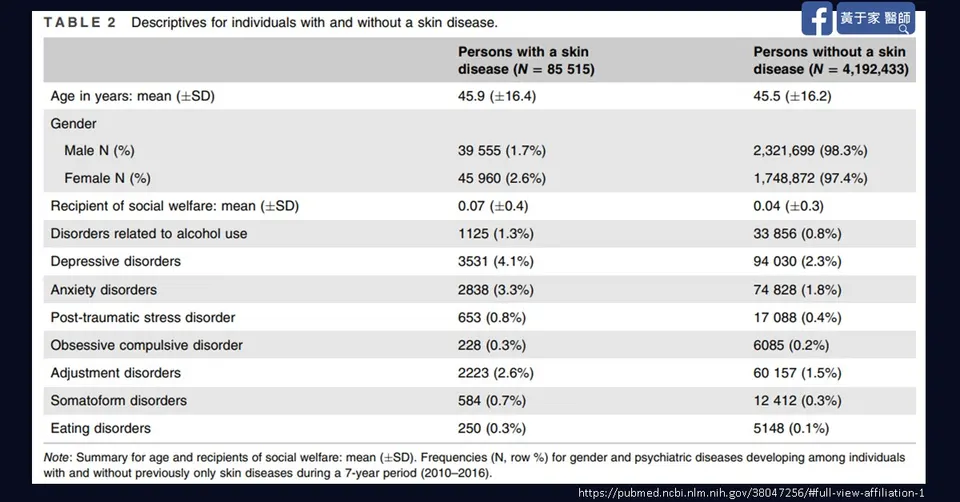
Dermatological patients developed depressive disorders most frequently (4.1% vs. 2.3% in non‐dermatological participants), followed by anxiety disorders (3.3% vs. 1.8%), and adjustment disorders (2.6% vs. 1.5%). Developing depressive disorders showed the highest HR among dermatological patients, HR (95% CI) = 2.5 (2.4–2.5), followed by disorders related to alcohol use, HR (95% CI) = 2.2 (2.1–2.5), and anxiety disorders, HR (95% CI) = 2.1 (2.1–2.2). Papulosquamous disorders were the skin conditions with the highest HR for developing a mental health condition, with depressive disorder having HR (95% CI) = 2.6 (2.5–2.9); anxiety disorders at HR (95% CI) = 2.9 (2.7–3.1); and disorders related to alcohol use at HR (95% CI) = 3.2 (2.8–3.6).
Conclusions
The study demonstrates that having a skin disease doubles to triples the risk of developing a psychiatric illness within 7 years, especially depression, anxiety, and alcohol use compared with the general population.
原始論文
Balieva F, Abebe DS, Dalgard FJ, Lien L. Skin Health and Disease. 2023;3(6):e294. doi:10.1002/ski2.294
論文摘要(Google 翻譯)
以下為 Google 翻譯,並校正明顯錯誤,僅供參考,內容以英文原文為準。
成年皮膚病患者發生精神疾病的風險:挪威一項為期 9 年的全國登記資料追蹤研究
背景:過去數十年來,皮膚病與精神共病之間的關聯日益受到關注。壓力與精神疾病可直接或間接影響皮膚病,而已知會損害生活品質與心理健康的皮膚病,也可能促成精神疾病。
目的:本研究旨在評估成年皮膚病患者在一段期間內發生精神疾病的風險。次要目的是了解哪些精神疾病最常發生,以及哪些皮膚病對日後心理健康問題的風險最大。
方法:利用挪威患者登記資料庫,追蹤成年皮膚病患者 9 年(2008–2016 年),涵蓋門診與住院的專科醫療服務。在前 2 年找出皮膚病患者,再於接下來 7 年前瞻性追蹤其精神共病。
以 Cox 迴歸模型估計皮膚病患者發生精神疾病的風險。估計值已校正年齡與性別差異。結果以風險比(HR)及 95% 信賴區間(CI)呈現。
結果:皮膚病患者最常發生憂鬱症(4.1%,非皮膚病參與者為 2.3%),其次為焦慮症(3.3% 對 1.8%)與適應障礙(2.6% 對 1.5%)。在皮膚病患者中,發生憂鬱症的 HR 最高,HR(95% CI)= 2.5(2.4–2.5),其次為酒精使用相關疾患,HR(95% CI)= 2.2(2.1–2.5),以及焦慮症,HR(95% CI)= 2.1(2.1–2.2)。丘疹鱗屑性疾病是發生心理健康問題 HR 最高的皮膚病,其中憂鬱症 HR(95% CI)= 2.6(2.5–2.9);焦慮症 HR(95% CI)= 2.9(2.7–3.1);酒精使用相關疾患 HR(95% CI)= 3.2(2.8–3.6)。
結論:本研究顯示,與一般族群相比,罹患皮膚病者在 7 年內發生精神疾病的風險增加兩到三倍,尤其是憂鬱、焦慮及酒精使用問題。
全文連結,請見這裡(外部網站)。
更多期刊研究整理,請見這裡。
異位性皮膚炎,期刊研究,請看這裡。
乾癬,期刊研究,請看這裡。
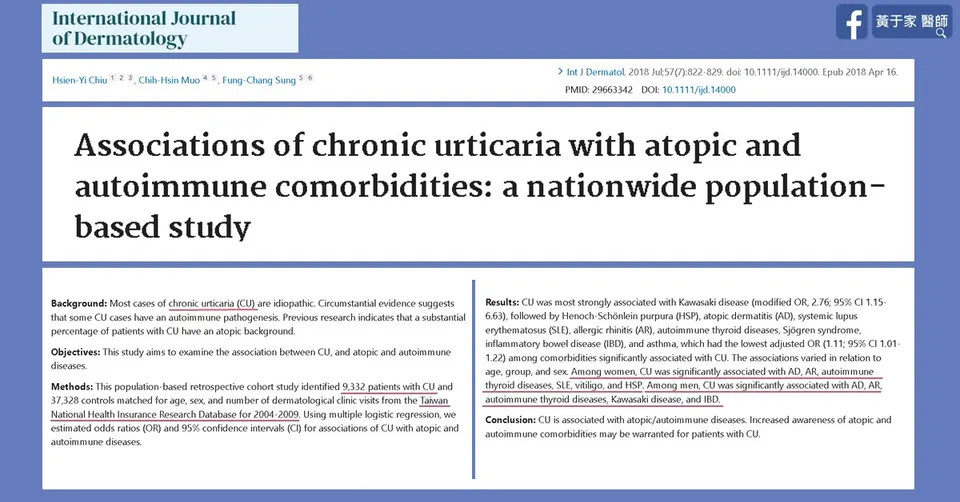
慢性蕁麻疹,期刊研究,請看這裡。
依據挪威健保研究,皮膚患者往往有較高比例會合併身心問題(憂鬱、焦慮、酗酒),且由於皮膚問題時常伴隨睡眠障礙。
導致患者得喝提神飲料以維持日常活動,但提神飲料又會引發情緒問題,諸如注意力不集中、焦慮、自殺念頭,使身心問題更是雪上加霜,新聞連結請見這裡(外部網站)。
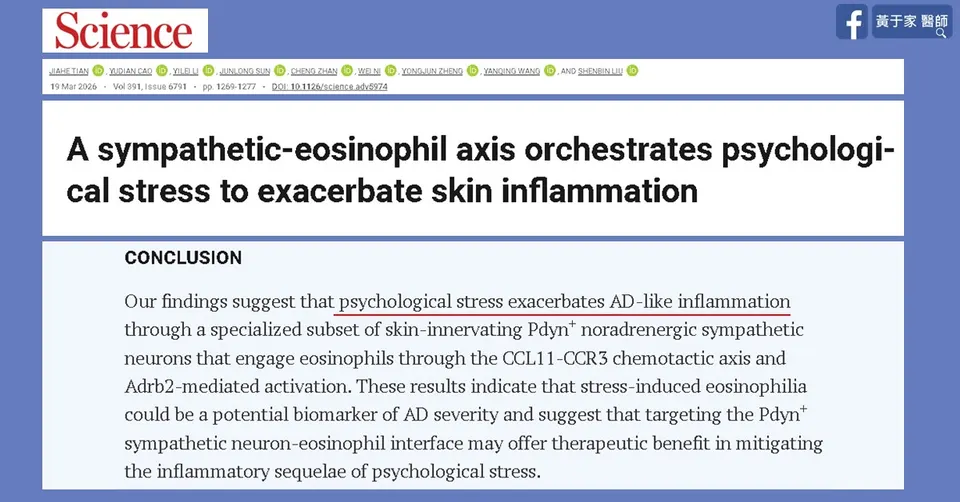
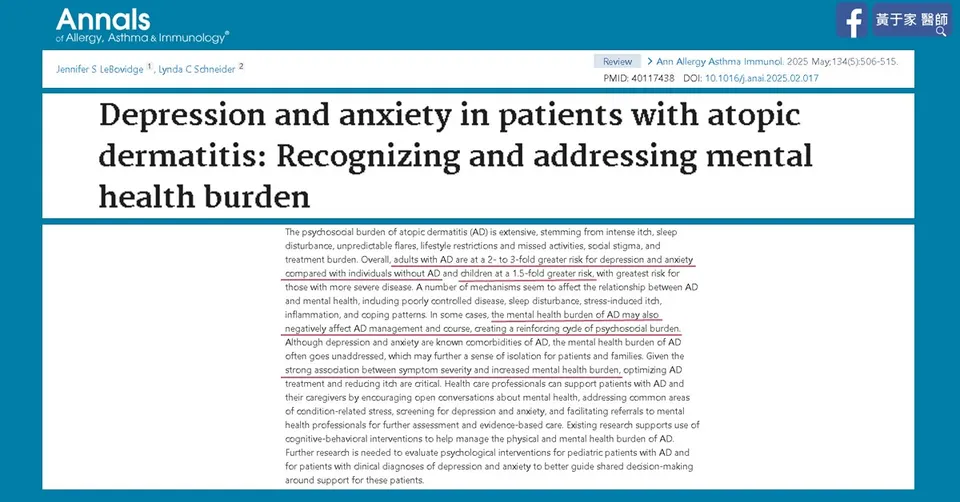
這也呼應了頂尖期刊 Science 的研究:壓力會導致異位性皮膚炎惡化。
接下來讀這幾篇
原文發表於 作者部落格(舊部落格)。