乾癬與高鹽飲食有關,吃越鹹,乾癬發生風險越高 - 英國研究
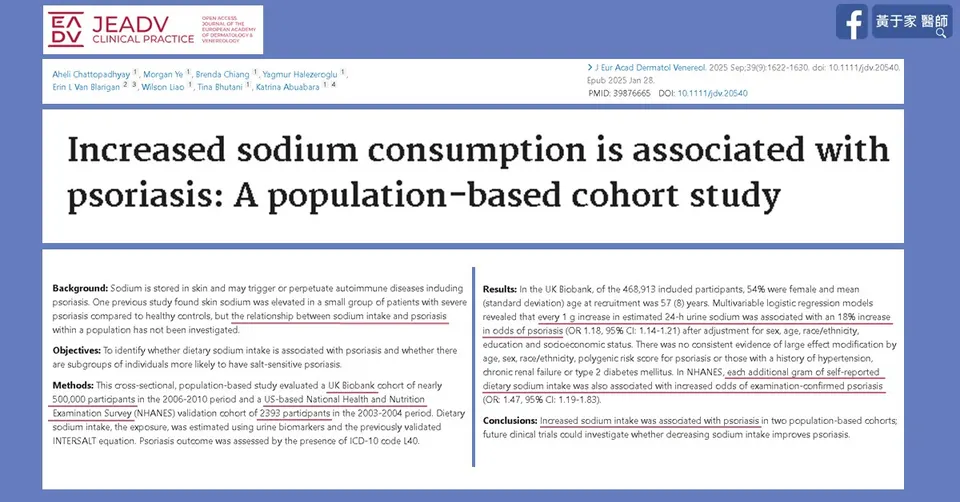
本篇研究,“Increased sodium consumption is associated with psoriasis: A population-based cohort study”,請見這裡(外部網站),期刊摘要如下:
Background:
Sodium is stored in skin and may trigger or perpetuate autoimmune diseases including psoriasis.
One previous study found skin sodium was elevated in a small group of patients with severe psoriasis compared to healthy controls, but the relationship between sodium intake and psoriasis within a population has not been investigated.
Objectives:
To identify whether dietary sodium intake is associated with psoriasis and whether there are subgroups of individuals more likely to have salt-sensitive psoriasis.
Methods:
This cross-sectional, population-based study evaluated a UK Biobank cohort of nearly 500,000 participants in the 2006-2010 period and a US-based National Health and Nutrition Examination Survey (NHANES) validation cohort of 2393 participants in the 2003-2004 period.
Dietary sodium intake, the exposure, was estimated using urine biomarkers and the previously validated INTERSALT equation. Psoriasis outcome was assessed by the presence of ICD-10 code L40.
Results:
In the UK Biobank, of the 468,913 included participants, 54% were female and mean (standard deviation) age at recruitment was 57 (8) years.
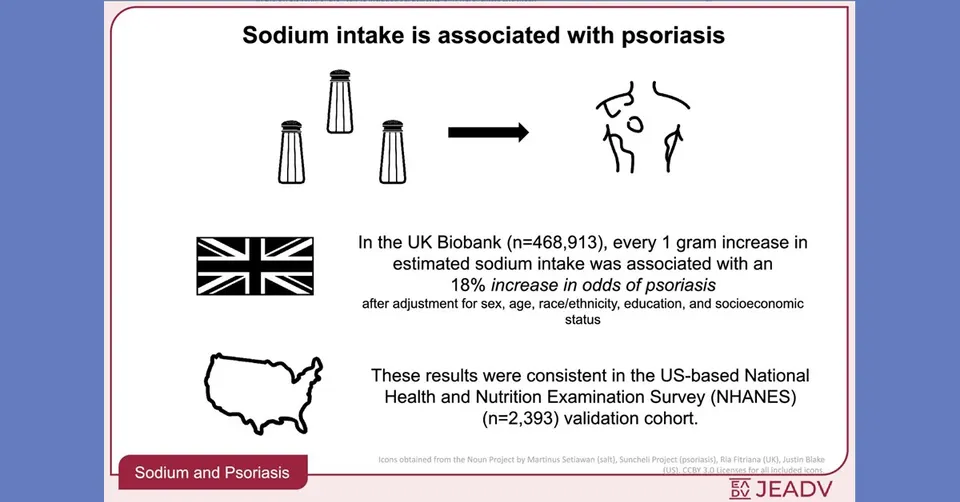
Multivariable logistic regression models revealed that every 1 g increase in estimated 24-h urine sodium was associated with an 18% increase in odds of psoriasis (OR 1.18, 95% CI: 1.14-1.21) after adjustment for sex, age, race/ethnicity, education and socioeconomic status.
There was no consistent evidence of large effect modification by age, sex, race/ethnicity, polygenic risk score for psoriasis or those with a history of hypertension, chronic renal failure or type 2 diabetes mellitus.
In NHANES, each additional gram of self-reported dietary sodium intake was also associated with increased odds of examination-confirmed psoriasis (OR: 1.47, 95% CI: 1.19-1.83).
Conclusions:
Increased sodium intake was associated with psoriasis in two population-based cohorts; future clinical trials could investigate whether decreasing sodium intake improves psoriasis.
原始論文
Increased sodium consumption is associated with psoriasis: A population-based cohort study(外部網站)
Chattopadhyay A, Ye M, Chiang B, Halezeroglu Y, et al. Journal of the European Academy of Dermatology and Venereology. 2025;39(9):1622-1630. doi:10.1111/jdv.20540
論文摘要(Google 翻譯)
以下為 Google 翻譯,並校正明顯錯誤,僅供參考,內容以英文原文為準。
鈉攝取增加與乾癬相關:一項以族群為基礎的世代研究
背景:鈉會儲存在皮膚中,並可能誘發或延續包括乾癬在內的自體免疫疾病。
先前一項研究發現,一小群重度乾癬患者的皮膚鈉含量高於健康對照者,但在族群中,鈉攝取量與乾癬之間的關係尚未被研究。
目的:確認飲食鈉攝取是否與乾癬相關,以及是否有某些次族群較可能出現鹽敏感型乾癬。
方法:這項以族群為基礎的橫斷面研究,評估 2006–2010 年間近 50 萬名參與者的英國生物資料庫(UK Biobank)世代,以及 2003–2004 年間 2393 名參與者的美國國家健康與營養檢查調查(NHANES)驗證世代。
飲食鈉攝取量(即暴露因子)以尿液生物標記及先前已驗證的 INTERSALT 公式估算。乾癬結果以是否有 ICD-10 代碼 L40 判定。
結果:英國生物資料庫納入的 468,913 名參與者中,54% 為女性,收案時平均(標準差)年齡為 57(8)歲。
多變項邏輯斯迴歸模型顯示,在校正性別、年齡、種族/族裔、教育程度與社經地位後,估計的 24 小時尿鈉每增加 1 公克,罹患乾癬的勝算增加 18%(OR 1.18,95% CI:1.14–1.21)。
沒有一致證據顯示年齡、性別、種族/族裔、乾癬多基因風險分數,或有高血壓、慢性腎衰竭、第 2 型糖尿病病史者,會產生大幅的效應修飾。
在 NHANES 中,自述的飲食鈉攝取量每多 1 公克,也與經檢查確認的乾癬勝算增加相關(OR:1.47,95% CI:1.19–1.83)。
結論:在兩個以族群為基礎的世代中,鈉攝取增加與乾癬相關;未來的臨床試驗可探討減少鈉攝取是否能改善乾癬。
乾癬,中醫經方的治療實例,請見這裡。
乾癬,期刊研究,請看這裡。
期刊研究整理,請見這裡。
接下來讀這幾篇
原文發表於 作者部落格(舊部落格)。