乾癬控制越差,共病會越多也越重,如糖尿病、心血管疾病、肝病、腎病、胃潰瘍、風濕病:英國研究
乾癬,中醫經方的治療實例,請見這裡。
乾癬,期刊研究,請看這裡。
期刊研究整理,請見這裡。
本篇研究全文,請見這裡(外部網站)。
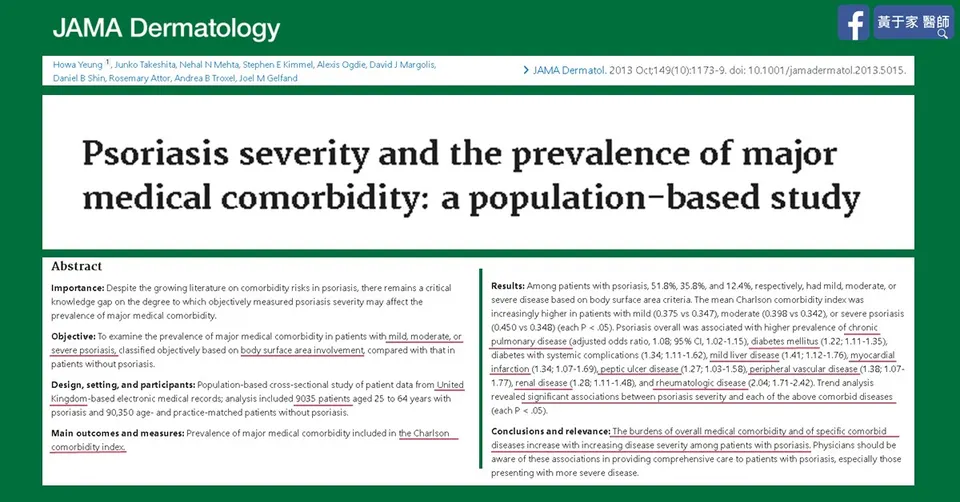
Importance:Despite the growing literature on comorbidity risks in psoriasis, there remains a critical knowledge gap on the degree to which objectively measured psoriasis severity may affect the prevalence of major medical comorbidity.
Objective:To examine the prevalence of major medical comorbidity in patients with mild, moderate, or severe psoriasis, classified objectively based on body surface area involvement, compared with that in patients without psoriasis.
Design, setting, and participants:Population-based cross-sectional study of patient data from United Kingdom-based electronic medical records; analysis included 9035 patients aged 25 to 64 years with psoriasis and 90,350 age- and practice-matched patients without psoriasis.
Main outcomes and measures: Prevalence of major medical comorbidity included in the Charlson comorbidity index.
Results:Among patients with psoriasis, 51.8%, 35.8%, and 12.4%, respectively, had mild, moderate, or severe disease based on body surface area criteria.
The mean Charlson comorbidity index was increasingly higher in patients with mild (0.375 vs 0.347), moderate (0.398 vs 0.342), or severe psoriasis (0.450 vs 0.348) (each P < .05).
Psoriasis overall was associated with higher prevalence of chronic pulmonary disease (adjusted odds ratio, 1.08; 95% CI, 1.02-1.15), diabetes mellitus (1.22; 1.11-1.35), diabetes with systemic complications (1.34; 1.11-1.62), mild liver disease (1.41; 1.12-1.76), myocardial infarction (1.34; 1.07-1.69), peptic ulcer disease (1.27; 1.03-1.58), peripheral vascular disease (1.38; 1.07-1.77), renal disease (1.28; 1.11-1.48), and rheumatologic disease (2.04; 1.71-2.42).
Trend analysis revealed significant associations between psoriasis severity and each of the above comorbid diseases (each P < .05).
Conclusions and relevance:The burdens of overall medical comorbidity and of specific comorbid diseases increase with increasing disease severity among patients with psoriasis.
Physicians should be aware of these associations in providing comprehensive care to patients with psoriasis, especially those presenting with more severe disease.
原始論文
Psoriasis severity and the prevalence of major medical comorbidity: a population-based study(外部網站)
Yeung H, Takeshita J, Mehta NN, Kimmel SE, et al. JAMA Dermatology. 2013;149(10):1173-1179. doi:10.1001/jamadermatol.2013.5015
論文摘要(Google 翻譯)
以下為 Google 翻譯,並校正明顯錯誤,僅供參考,內容以英文原文為準。
乾癬嚴重度與主要共病的盛行率:一項以族群為基礎的研究
重要性:儘管關於乾癬共病風險的文獻日益增加,但以客觀方式測量的乾癬嚴重度對主要內科共病盛行率的影響程度,仍存在關鍵的知識缺口。
目的:檢視依體表面積受侵犯程度客觀分類的輕度、中度或重度乾癬患者中,主要內科共病的盛行率,並與無乾癬患者比較。
設計、場域與參與者:以英國電子病歷之患者資料進行的族群橫斷面研究;分析納入 9035 名 25 至 64 歲的乾癬患者,以及 90,350 名年齡與所屬診所相配對的無乾癬患者。
主要結果與測量指標:Charlson 共病指數所列主要內科共病的盛行率。
結果:依體表面積標準,乾癬患者中分別有 51.8%、35.8% 與 12.4% 為輕度、中度或重度。
輕度(0.375 對 0.347)、中度(0.398 對 0.342)與重度乾癬(0.450 對 0.348)患者的平均 Charlson 共病指數依序升高(皆 P < .05)。
整體而言,乾癬與下列疾病的盛行率較高相關:慢性肺病(校正勝算比 1.08;95% CI 1.02–1.15)、糖尿病(1.22;1.11–1.35)、糖尿病合併全身性併發症(1.34;1.11–1.62)、輕度肝病(1.41;1.12–1.76)、心肌梗塞(1.34;1.07–1.69)、消化性潰瘍(1.27;1.03–1.58)、周邊血管疾病(1.38;1.07–1.77)、腎臟疾病(1.28;1.11–1.48)及風濕免疫疾病(2.04;1.71–2.42)。
趨勢分析顯示,乾癬嚴重度與上述每一種共病之間皆有顯著關聯(皆 P < .05)。
結論與意義:乾癬患者的整體內科共病負擔與特定共病負擔,皆隨疾病嚴重度增加而上升。
醫師在為乾癬患者提供全面照護時,應留意這些關聯,特別是病情較嚴重的患者。
接下來讀這幾篇
原文發表於 作者部落格(舊部落格)。