乾癬患者常合併痛風:台灣健保資料庫研究結果
乾癬,中醫經方的治療實例,請見這裡。
乾癬,期刊研究,請看這裡。
期刊研究整理,請見這裡。
本篇研究全文,請見這裡(外部網站)。
原始論文
The Risk of Gout in Patients with Psoriasis: A Population-Based Cohort Study in Taiwan(外部網站)
Wei JC, Chang YJ, Wang YH, Yeh CJ. Clinical Epidemiology. 2022;14:265-273. doi:10.2147/CLEP.S346128
論文摘要(英文原文)
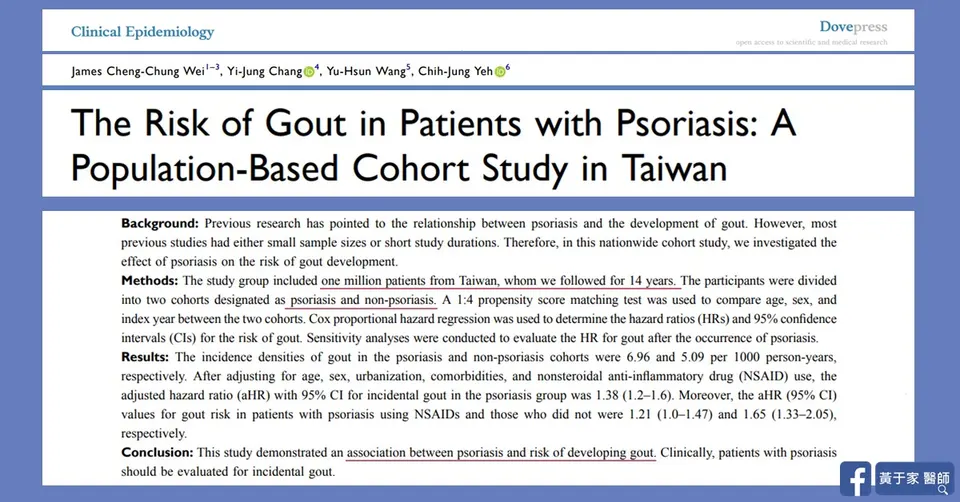
The Risk of Gout in Patients with Psoriasis: A Population-Based Cohort Study in Taiwan
Background: Previous research has pointed to the relationship between psoriasis and the development of gout. However, most previous studies had either small sample sizes or short study durations. Therefore, in this nationwide cohort study, we investigated the effect of psoriasis on the risk of gout development.
Methods: The study group included one million patients from Taiwan, whom we followed for 14 years. The participants were divided into two cohorts designated as psoriasis and non-psoriasis. A 1:4 propensity score matching test was used to compare age, sex, and index year between the two cohorts. Cox proportional hazard regression was used to determine the hazard ratios (HRs) and 95% confidence intervals (CIs) for the risk of gout. Sensitivity analyses were conducted to evaluate the HR for gout after the occurrence of psoriasis.
Results: The incidence densities of gout in the psoriasis and non-psoriasis cohorts were 6.96 and 5.09 per 1000 person-years, respectively. After adjusting for age, sex, urbanization, comorbidities, and nonsteroidal anti-inflammatory drug (NSAID) use, the adjusted hazard ratio (aHR) with 95% CI for incidental gout in the psoriasis group was 1.38 (1.2-1.6). Moreover, the aHR (95% CI) values for gout risk in patients with psoriasis using NSAIDs and those who did not were 1.21 (1.0-1.47) and 1.65 (1.33-2.05), respectively.
Conclusion: This study demonstrated an association between psoriasis and risk of developing gout. Clinically, patients with psoriasis should be evaluated for incidental gout.
論文摘要(Google 翻譯)
以下為 Google 翻譯,並校正明顯錯誤,僅供參考,內容以英文原文為準。
乾癬患者痛風的風險:台灣以族群為基礎的世代研究
背景:先前的研究已指出乾癬與痛風發展之間的關係。然而,之前的大多數研究不是樣本數少,就是研究期間短。因此,在這項全國性世代研究中,我們研究了乾癬對痛風發展風險的影響。
方法:研究組包括來自台灣的 100 萬名患者,我們對他們進行了 14 年的追蹤調查。參與者被分為乾癬和非乾癬兩組。採用 1:4 傾向分數配對來比較兩個世代之間的年齡、性別和納入年份。 Cox 比例風險迴歸用於確定痛風風險的風險比 (HR) 和 95% 信賴區間 (CI)。進行敏感度分析來評估乾癬發生後痛風的 HR。
結果:乾癬組和非乾癬組的痛風發生密度分別為每1000人年6.96例和5.09例。在調整年齡、性別、都市化、合併症和非類固醇類抗發炎藥物 (NSAID) 使用後,乾癬組新發生痛風的調整後風險比 (aHR) 為 1.38(95% CI 1.2–1.6)。此外,使用 NSAID 的乾癬患者和未使用 NSAID 的乾癬患者的痛風風險 aHR (95% CI) 值分別為 1.21 (1.0-1.47) 和 1.65 (1.33-2.05)。
結論:這項研究證明了乾癬與痛風風險之間存在關聯。臨床上,乾癬患者應評估是否新發生痛風。
接下來讀這幾篇
原文發表於 作者部落格(舊部落格)。