外泌體併發症期刊報導 - 醫療產品並不是越新就越好
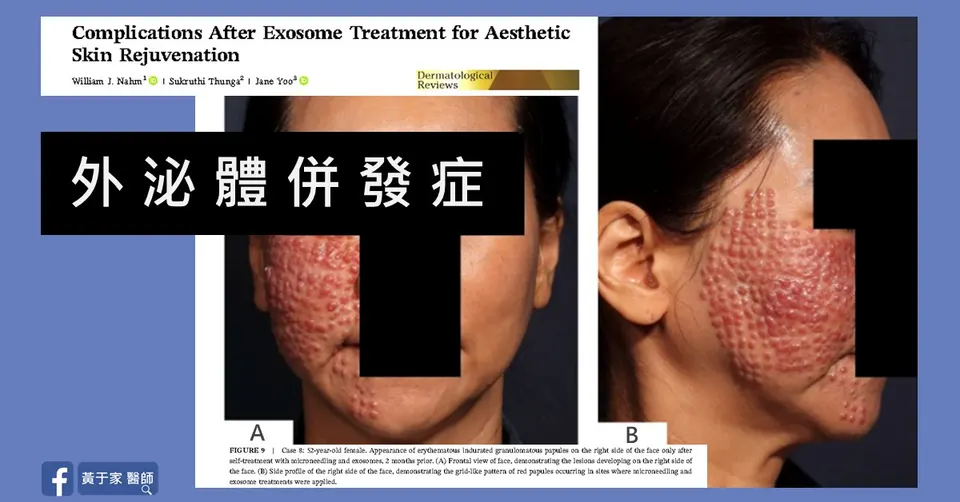
本篇研究全文,請見這裡(外部網站)。
原始論文
Complications After Exosome Treatment for Aesthetic Skin Rejuvenation(外部網站)
Nahm WJ, Thunga S, Yoo J. Dermatological Reviews. 2024;5(4). doi:10.1002/der2.242
論文摘要(英文原文)
Complications After Exosome Treatment for Aesthetic Skin Rejuvenation
Background: Exosomes have gained significant attention in aesthetic dermatology for their potential in skin rejuvenation. Despite numerous studies investigating the use of exosomes in aesthetic applications, no adverse events have been reported thus far. This case series presents patients with noticeable adverse effects following the application of exosomes to the skin for aesthetic purposes primarily in South Korea, including one patient residing in Australia. [Correction added on 4 February 2025, after first online publication: In the Abstract, one patient residing in Australia has been included.]
Methods: A consortium of concerned aesthetic dermatologists from South Korea provided a case series of patients who developed complications after receiving exosome treatments for skin rejuvenation. The case series included seven female patients, ranging in age from 26 to 37 years old, who developed delayed‐onset granulomatous lesions at the treatment sites. [Correction added on 4 February 2025, after first online publication: the number of patients has been changed from eight to seven females; the age range has been changed from 26 to 52 years old to 26 to 37 years old.]
Results: All patients in the case series developed erythematous, indurated papules or nodules at the sites of exosome injections, with onset ranging from 2 weeks to 3 months posttreatment. Histopathological examination of biopsied lesions revealed necrotizing granulomas not related to mycobacterial infections. The patients’ response to topical and oral steroids, as well as other treatments, varied.
Conclusion: Although exosome‐based therapies hold great promise in aesthetic dermatology, this case series highlights the potential for delayed‐onset granulomatous complications following exosome treatments for skin rejuvenation. Standardized protocols for exosome isolation and purification, as well as rigorous safety and efficacy standards, are needed to ensure the successful implementation of exosome‐based products in clinical settings.
論文摘要(Google 翻譯)
以下為 Google 翻譯,並校正明顯錯誤,僅供參考,內容以英文原文為準。
用於美容嫩膚的外泌體治療後的併發症
背景:外泌體因其在皮膚年輕化方面的潛力而在美容皮膚科中獲得了極大的關注。儘管有大量研究調查外泌體在美容應用中的使用,但迄今尚無不良事件的報告。此病例系列介紹了主要在韓國出於美容目的將外泌體應用於皮膚後出現明顯不良反應的患者,其中包括一名居住在澳洲的患者。 [2025 年 2 月 4 日更正:摘要中加入一名居住在澳洲的患者。]
方法:來自韓國的美容皮膚科醫師聯盟提供了一系列接受外泌體嫩膚治療後出現併發症的患者病例。此病例系列包括 7 名女性患者,年齡從 26 歲到 37 歲不等,她們在治療部位出現遲發性肉芽腫性病變。 [2025 年 2 月 4 日更正:患者人數由 8 名改為 7 名女性;年齡範圍由 26–52 歲改為 26–37 歲。]
結果:病例系列中的所有患者在外泌體注射部位均出現紅斑、硬結丘疹或結節,發病時間為治療後 2 週至 3 個月。切片病灶的組織病理學檢查顯示與分枝桿菌感染無關的壞死性肉芽腫。患者對外用與口服類固醇以及其他治療的反應各不相同。
結論:儘管外泌體療法在美容皮膚科中具有廣闊的前景,但該病例系列強調了外泌體嫩膚治療後出現遲發性肉芽腫併發症的可能性。需要外泌體分離和純化的標準化方案以及嚴格的安全性和有效性標準,以確保外泌體產品在臨床環境中的成功實施。
其它期刊研究整理,請見這裡。
接下來讀這幾篇
原文發表於 作者部落格(舊部落格)。